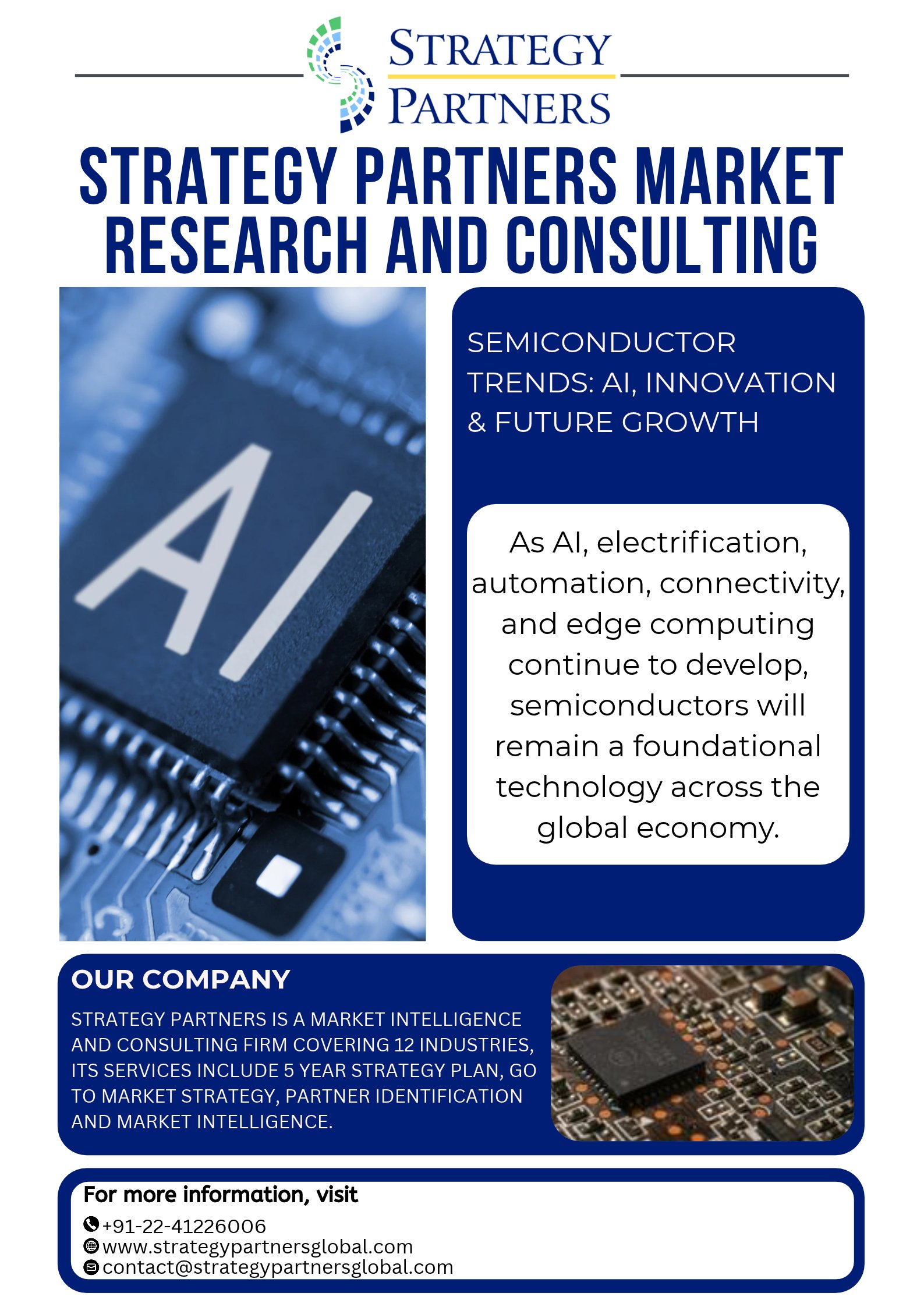
The semiconductor industry has become a critical foundation of the global digital economy, supporting artificial intelligence (AI), smartphones, cloud computing, automotive electronics, telecommunications, industrial automation, aerospace, and defense systems. As digital technologies become increasingly embedded in everyday products and strategic infrastructure, demand for advanced semiconductor components continues to expand.
Artificial intelligence is currently one of the most important forces reshaping the semiconductor landscape. AI workloads require powerful processors, high-bandwidth memory, advanced networking components, and energy-efficient computing architectures. At the same time, semiconductor manufacturers are investing in smaller process nodes, advanced packaging, new materials, and specialized chips to meet the performance requirements of emerging applications.
The industry is also undergoing significant changes in manufacturing and supply chains. Governments and companies are investing in domestic semiconductor production to strengthen supply-chain resilience, reduce dependence on concentrated manufacturing locations, and secure access to strategically important technologies.
AI and Advanced Computing Drive Semiconductor Demand
AI is transforming semiconductor demand by creating requirements for high-performance computing hardware. Training and running large AI models require significant processing power and memory bandwidth, encouraging manufacturers to develop specialized accelerators and advanced processors.
Graphics processing units (GPUs) have become important for AI workloads because of their ability to perform large numbers of parallel calculations. However, the semiconductor ecosystem is expanding beyond GPUs. Application-specific integrated circuits (ASICs), tensor processing units, neural processing units (NPUs), and other AI accelerators are being developed for data centers, cloud platforms, personal computers, smartphones, and edge devices.
Edge AI is another important trend. Instead of sending every workload to a centralized data center, edge devices can process information locally. This approach can reduce latency, lower network requirements, and support applications where rapid decision-making is important. Smartphones, industrial machines, vehicles, cameras, and robotics systems are increasingly incorporating dedicated AI processing capabilities.
The expansion of AI infrastructure is also increasing demand for high-bandwidth memory (HBM), advanced networking chips, power-management semiconductors, and data-center processors. Consequently, AI growth is influencing multiple layers of the semiconductor value chain rather than a single category of chip.
Advanced Manufacturing and Semiconductor Innovation
Semiconductor manufacturers continue to pursue smaller process technologies to increase transistor density and improve performance and power efficiency. Advanced process nodes are particularly important for high-performance processors used in AI, smartphones, data centers, and other computing applications.
However, semiconductor innovation is no longer focused exclusively on reducing transistor dimensions. Advanced packaging has become an equally important area of development. Technologies such as chiplets, 2.5D packaging, 3D integration, and heterogeneous integration allow multiple semiconductor components to be combined within a single package.
Chiplet architectures can enable manufacturers to integrate different processing, memory, connectivity, and specialized functions into a common system. This approach can provide greater design flexibility and help address the challenges associated with manufacturing extremely large monolithic chips.
Three-dimensional integration is also gaining attention as semiconductor companies seek to improve performance while managing space and power constraints. By stacking components vertically, manufacturers can shorten interconnects and potentially improve data transfer efficiency.
New semiconductor materials are also being explored. Silicon remains the dominant material for most semiconductor applications, but wide-bandgap materials such as silicon carbide (SiC) and gallium nitride (GaN) are becoming increasingly important. These materials can offer advantages in high-power and high-frequency applications.
SiC is particularly relevant to electric vehicles, charging infrastructure, renewable energy systems, and industrial power electronics. GaN is being adopted for applications such as high-frequency power conversion, communications, consumer electronics, and advanced power-management systems.
Automotive, Connectivity and Industrial Applications
The automotive sector is becoming a major source of semiconductor demand. Modern vehicles contain semiconductor components across power management, infotainment, safety systems, connectivity, advanced driver-assistance systems (ADAS), and vehicle control systems.
The development of electric vehicles is further increasing semiconductor requirements. Electric powertrains depend on power semiconductors to control energy flow between batteries, motors, and other electrical systems. SiC-based power devices are gaining attention because of their potential to improve efficiency in high-voltage applications.
ADAS and autonomous driving technologies are also creating demand for high-performance processors, radar chips, image sensors, LiDAR components, and communication technologies. As vehicles become more software-defined, semiconductor content is expected to remain an important component of automotive innovation.
Beyond automotive applications, industrial automation is contributing to semiconductor demand. Smart factories use sensors, microcontrollers, processors, connectivity devices, and power-management components to monitor equipment and automate production processes.
The Internet of Things (IoT) is another major application area. Connected sensors and devices require low-power processors and communication chips capable of operating efficiently for extended periods. As industrial IoT, smart buildings, healthcare devices, and connected infrastructure expand, semiconductor demand is becoming increasingly diversified.
Supply Chain Resilience and Semiconductor Manufacturing
The global semiconductor supply chain has become a strategic priority for governments and businesses. Semiconductor production requires highly specialized manufacturing facilities, advanced equipment, sophisticated materials, and complex international supply networks.
Recent supply-chain disruptions have encouraged companies and governments to strengthen domestic and regional semiconductor manufacturing capabilities. Major economies are supporting new fabrication facilities, packaging plants, research programs, and semiconductor workforce development.
The expansion of fabrication capacity is accompanied by efforts to develop local ecosystems for semiconductor equipment, chemicals, materials, design services, and testing. This trend could gradually create a more geographically diversified semiconductor supply chain.
At the same time, semiconductor manufacturing remains capital-intensive. Building advanced fabrication facilities requires significant investment, highly skilled personnel, reliable infrastructure, and access to specialized manufacturing equipment. As a result, collaboration between governments, semiconductor manufacturers, technology companies, and research institutions is becoming increasingly important.
Future Growth Opportunities in the Semiconductor Industry
The future growth of the semiconductor industry will be closely connected to several emerging technologies. AI is likely to remain a major demand driver, particularly as AI applications expand from centralized data centers into PCs, smartphones, vehicles, industrial equipment, and edge devices.
Quantum computing could create new requirements for specialized semiconductor components, although the technology remains at an earlier stage of commercial development. Photonic technologies may also gain importance as data movement becomes a growing constraint in high-performance computing and AI infrastructure.
The aerospace and defense sectors represent another strategic application area. Modern radar systems, electronic warfare platforms, satellites, unmanned systems, avionics, and precision-guided systems require advanced processors, sensors, RF components, and radiation-tolerant semiconductor technologies. Increasing demand for autonomous platforms and sophisticated sensing systems could create additional opportunities for specialized semiconductor manufacturers.
Cybersecurity is also becoming increasingly important as connected semiconductor-enabled devices become more widespread. Hardware-based security features, secure processors, trusted execution environments, and authentication technologies can help protect devices and critical infrastructure from cyber threats.
Energy efficiency will remain a central industry priority. As AI data centers and high-performance computing systems consume increasing amounts of electricity, semiconductor manufacturers will face greater pressure to improve computational performance while reducing power consumption. Advances in transistor architectures, packaging, memory technologies, and power semiconductors will therefore play an important role in future industry development.
The semiconductor industry is entering a period defined by AI adoption, advanced manufacturing, supply-chain diversification, and increasing demand across automotive, industrial, telecommunications, aerospace, and consumer applications. Semiconductor innovation is expanding beyond traditional transistor scaling toward advanced packaging, specialized processors, new materials, and heterogeneous computing architectures.
As AI, electrification, automation, connectivity, and edge computing continue to develop, semiconductors will remain a foundational technology across the global economy. Companies that invest in manufacturing capacity, advanced process technologies, packaging capabilities, specialized chips, and resilient supply chains will play an important role in shaping the next phase of semiconductor industry growth.