
Introduction
Packaging plays an essential role in protecting products, extending shelf life, supporting transportation, and providing information to consumers. However, the widespread use of conventional plastic packaging has created significant environmental concerns. Many traditional plastics are manufactured from fossil-based resources and can persist in the environment for decades or longer after disposal. Growing concerns about plastic pollution, resource consumption, and waste management are encouraging businesses to explore more sustainable alternatives.
Biodegradable packaging has emerged as an important technology in this transition. Designed to break down through the action of microorganisms under suitable environmental conditions, biodegradable packaging can help reduce the long-term persistence associated with certain conventional packaging materials. Advances in material science are also enabling manufacturers to develop packaging solutions that balance environmental considerations with durability, functionality, and cost.
From food and beverages to pharmaceuticals, cosmetics, e-commerce, and consumer goods, biodegradable materials are creating new opportunities for packaging manufacturers. As governments, businesses, and consumers increasingly focus on sustainability, the technology is becoming an important part of the broader shift toward a circular and resource-efficient economy.
What Is Biodegradable Packaging?
Biodegradable packaging refers to packaging materials capable of being broken down by microorganisms such as bacteria and fungi into simpler substances under appropriate environmental conditions. The exact degradation process and timeframe depend on the material, temperature, moisture, oxygen availability, microorganisms, and disposal environment.
Biodegradable packaging can be produced using various natural or bio-based materials. Common examples include starch, cellulose, paper-based materials, polylactic acid (PLA), polyhydroxyalkanoates (PHAs), and other bio-derived polymers.
It is important to distinguish biodegradable packaging from compostable packaging. Compostable materials are designed to break down into useful organic matter under specified composting conditions, whereas biodegradable materials may require different environmental conditions and do not necessarily produce compost. Therefore, the terms should not automatically be treated as interchangeable.
The development of biodegradable packaging is increasingly focused on creating materials that can perform similar functions to conventional packaging while reducing environmental impacts across appropriate applications.
Key Materials Driving Biodegradable Packaging
Several materials are contributing to innovation in biodegradable packaging. Starch-based packaging is one of the widely explored options because starch is renewable and can be obtained from crops such as corn, potatoes, cassava, and wheat. It can be processed into films, coatings, foams, and molded packaging products.
Cellulose-based materials are another important category. Cellulose is abundant in plants and can be converted into films, fibers, coatings, and molded structures. Paper and fiber-based packaging can also be engineered to provide improved strength and barrier performance.
Polylactic acid (PLA) is a bio-based polymer commonly produced from fermented plant sugars. It can be processed using established plastic-manufacturing techniques and is used in applications such as food containers, films, cups, and other packaging products.
Polyhydroxyalkanoates (PHAs) are another group of bio-based polymers produced by microorganisms. Their properties can vary depending on their composition, allowing researchers to investigate their use in films, containers, coatings, and other packaging applications.
Natural fibers, agricultural residues, seaweed, and other biomass resources are also being investigated as potential feedstocks for sustainable packaging. These developments could expand the material base available to manufacturers while creating opportunities to utilize agricultural by-products.
How Biodegradable Packaging Is Transforming Industries
The food and beverage industry is one of the major areas where biodegradable packaging is gaining attention. Food packaging needs to provide protection against moisture, oxygen, contamination, and physical damage while maintaining product quality. Researchers are therefore developing biodegradable films and coatings with improved barrier properties.
In the e-commerce industry, packaging demand has increased significantly alongside online shopping. Lightweight and sustainable packaging materials can help companies address concerns about packaging waste while maintaining product protection during transportation.
The cosmetics and personal care sector is also exploring biodegradable and bio-based packaging formats. Brands are increasingly examining alternatives to conventional plastic containers, films, and secondary packaging as sustainability becomes a consideration in product development.
In pharmaceuticals and healthcare, packaging requirements are more demanding because materials must meet strict performance, safety, and regulatory requirements. Biodegradable materials are being studied for selected applications where their properties can meet these requirements.
Agricultural packaging is another emerging opportunity. Biodegradable films and related materials can potentially reduce persistent plastic waste associated with certain agricultural applications.
Technology and Innovation
Material engineering is playing a major role in improving biodegradable packaging. One of the biggest challenges has historically been achieving the necessary mechanical strength, flexibility, thermal stability, and barrier properties.
Researchers are developing bio-based coatings and multilayer structures to improve resistance to moisture, oxygen, oils, and other external factors. Nanotechnology is also being investigated to enhance mechanical and barrier performance through carefully engineered material structures.
Manufacturing technologies are evolving alongside materials. Extrusion, injection molding, thermoforming, coating, film processing, and additive manufacturing can be adapted for selected biodegradable materials.
Another important area is smart packaging. Researchers are combining biodegradable substrates with sensors, indicators, and other technologies to monitor freshness, temperature, or product conditions. The combination of sustainability and intelligent functionality could create new packaging solutions for food, pharmaceuticals, and logistics.
Artificial intelligence and advanced material modeling may further accelerate development by helping researchers identify material combinations and optimize packaging performance.
Benefits and Challenges
Biodegradable packaging offers several potential advantages. It can reduce dependence on some fossil-based packaging materials, support the use of renewable feedstocks, and potentially reduce the persistence of packaging waste under suitable degradation conditions.
The use of agricultural residues and other biomass resources may also support resource efficiency. For companies, sustainable packaging can contribute to broader environmental strategies and respond to increasing demand for responsible product design.
However, biodegradable packaging is not without challenges. Cost remains a major consideration, particularly when compared with established high-volume conventional plastics. Manufacturing capacity, raw material availability, processing requirements, and supply-chain infrastructure can influence the final price.
Performance is another challenge. Packaging materials must protect products throughout their intended shelf life. Some biodegradable materials can have limitations related to moisture resistance, heat tolerance, mechanical strength, or oxygen barrier properties.
End-of-life management is equally important. Not every biodegradable material will degrade effectively in every environment. Some compostable materials require industrial composting facilities with controlled temperature, humidity, and processing conditions. Therefore, appropriate waste-management infrastructure is essential for achieving the intended environmental benefits.
Clear labeling and consumer education can help prevent contamination between recycling, composting, and general waste streams.
Future Outlook
The future of biodegradable packaging is likely to be shaped by advances in material science, manufacturing efficiency, recycling infrastructure, and circular-economy strategies. Researchers are exploring new feedstocks, bio-based polymers, natural fibers, coatings, and composite materials to improve performance while reducing environmental impact.
Packaging manufacturers are also expected to focus increasingly on design for end-of-life. Instead of evaluating packaging only according to its production cost and functional performance, companies can consider how materials are sourced, manufactured, used, collected, processed, and ultimately disposed of.
Government policies and corporate sustainability commitments could further influence market development. Regulations targeting unnecessary or difficult-to-manage plastic packaging may encourage investment in alternative materials and packaging technologies.
The integration of biodegradable materials with reusable packaging, recyclable structures, lightweight designs, and digital tracking could also contribute to broader packaging innovation. Rather than replacing every conventional plastic application, biodegradable packaging is likely to become one component of a wider portfolio of sustainable packaging solutions.
Conclusion
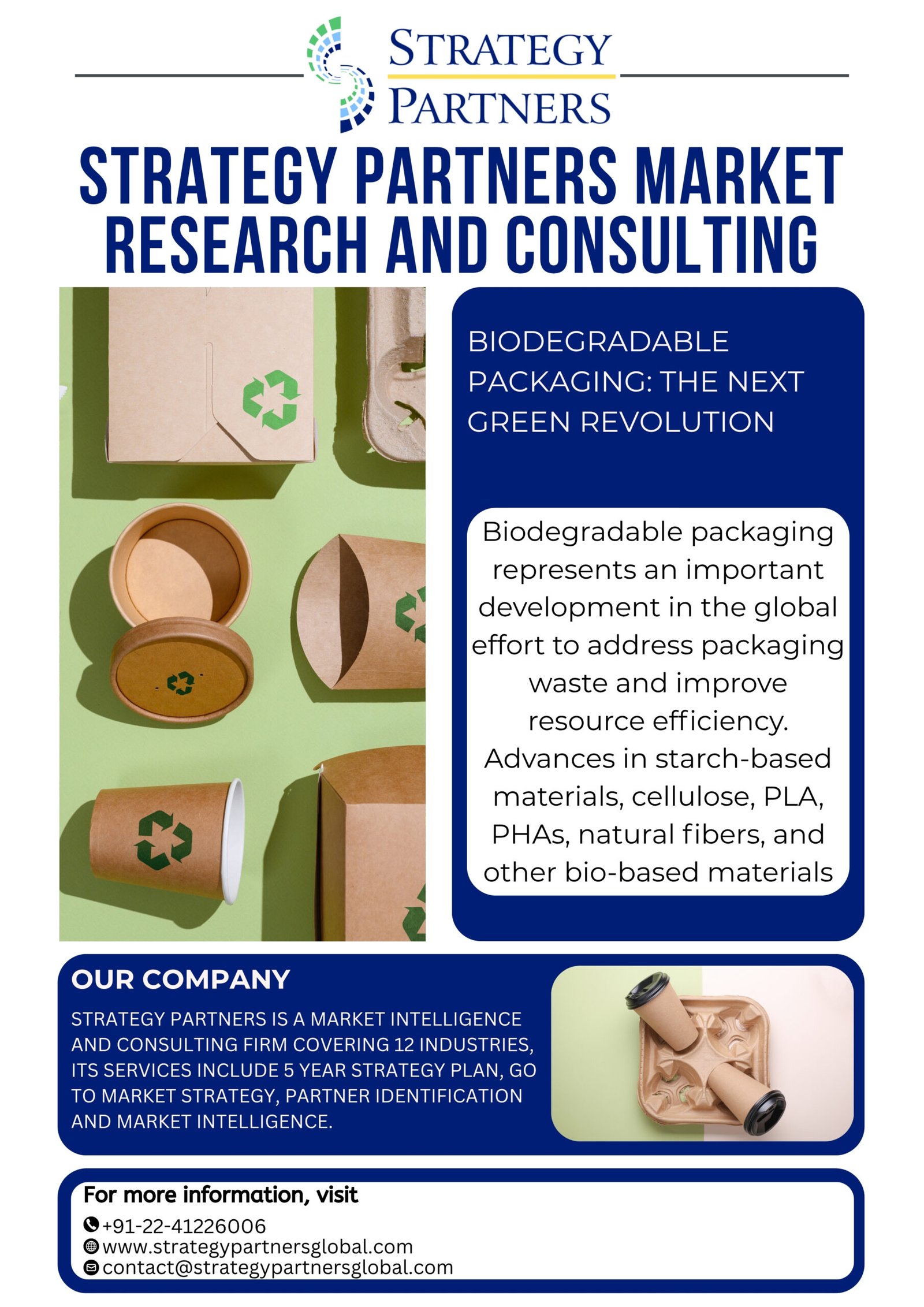
Biodegradable packaging represents an important development in the global effort to address packaging waste and improve resource efficiency. Advances in starch-based materials, cellulose, PLA, PHAs, natural fibers, and other bio-based materials are expanding the possibilities for sustainable packaging across multiple industries.
Although challenges related to cost, performance, infrastructure, and end-of-life management remain, continued research and manufacturing innovation are improving the potential of these materials. The most effective solutions will depend not only on whether a package is biodegradable, but also on its complete lifecycle, including material sourcing, production, transportation, use, collection, and disposal.
As businesses increasingly incorporate sustainability into product development and consumers become more aware of packaging impacts, biodegradable materials are positioned to play an important role in the evolution of modern packaging. The next phase of the packaging industry will likely focus on solutions that combine functionality, affordability, resource efficiency, and responsible end-of-life management, making biodegradable packaging an important part of the broader green revolution.