
The rapid growth of electric vehicles (EVs) is transforming the global automotive industry, and battery technology is at the center of this transition. While electric motors, power electronics, charging infrastructure, and vehicle software all play important roles, the battery remains one of the most critical components of an electric vehicle. It determines how far the vehicle can travel, how quickly it can be charged, how much it costs, and how efficiently it performs.
As governments, automakers, and consumers increasingly shift toward cleaner transportation, the development of more advanced battery technologies is becoming essential. The next generation of electric vehicles will depend on batteries that offer higher energy density, faster charging, longer service life, improved safety, and lower costs.
The Importance of Battery Technology in EVs
The battery pack serves as the primary energy storage system of an electric vehicle. Unlike conventional vehicles, which rely on internal combustion engines fueled by petrol or diesel, EVs use stored electrical energy to power an electric motor.
Battery performance has a direct influence on several key aspects of an electric vehicle. A higher-capacity battery can provide greater driving range, while improved charging technology can reduce the time required to recharge the vehicle. Battery weight also affects vehicle efficiency, handling, and overall performance.
For this reason, automakers and battery manufacturers are investing heavily in research and development. The objective is not simply to produce larger batteries, but to create energy storage systems that deliver more power and range without significantly increasing vehicle weight or cost.
Lithium-Ion Batteries Remain the Industry Standard
Lithium-ion technology currently dominates the electric vehicle battery market. These batteries offer a strong balance between energy density, performance, durability, and charging capability.
Modern EV battery packs are made up of thousands of individual cells that are grouped into modules and integrated into a larger battery pack. Battery management systems continuously monitor temperature, voltage, charging levels, and overall performance to ensure safe and efficient operation.
Different lithium-ion battery chemistries are also being used depending on vehicle requirements. Some are designed to deliver higher energy density and longer driving ranges, while others focus on lower costs, improved safety, and extended battery life.
Lithium-ion technology has improved significantly over the past decade. Advances in cell design, manufacturing processes, thermal management, and battery software have enabled automakers to introduce electric vehicles with increasingly competitive ranges and performance.
However, lithium-ion batteries still face challenges related to raw material availability, production costs, charging speed, and degradation over time. These factors are driving the development of next-generation battery technologies.
Increasing Energy Density for Greater Driving Range
One of the most important goals in EV battery development is improving energy density. Energy density refers to the amount of energy that can be stored within a specific weight or volume.
Higher energy density allows manufacturers to increase vehicle range without making battery packs significantly larger or heavier. This is particularly important for passenger vehicles, commercial trucks, and other applications where weight has a major impact on efficiency.
Improved battery materials are expected to play a major role in achieving this objective. Researchers are exploring new cathode and anode materials that can store more energy and improve overall battery performance.
Silicon-based anodes, for example, are attracting attention because silicon can potentially store significantly more lithium than conventional graphite materials. However, managing the expansion and degradation of silicon during repeated charging cycles remains a technical challenge.
The successful commercialization of advanced materials could enable EV manufacturers to develop lighter battery packs capable of supporting longer driving ranges.
Solid-State Batteries and the Future of EVs
Solid-state battery technology is widely viewed as one of the most promising developments for the next generation of electric vehicles.
Conventional lithium-ion batteries use liquid electrolytes to transport ions between battery components. Solid-state batteries replace this liquid material with a solid electrolyte. This design has the potential to improve energy density, safety, and battery performance.
A solid-state battery could allow electric vehicles to travel longer distances while using a smaller or lighter battery pack. The technology may also reduce certain safety risks associated with flammable liquid electrolytes.
Another potential advantage is faster charging. Advanced solid-state designs could support improved charging performance, helping reduce one of the major concerns associated with EV adoption: charging time.
Despite these advantages, large-scale production remains challenging. Manufacturers must overcome issues related to material stability, durability, manufacturing complexity, and cost before solid-state batteries can be widely deployed across the automotive industry.
Nevertheless, continued investment suggests that solid-state technology could become an important part of the future EV battery landscape.
Faster Charging Technologies
Charging speed is becoming an increasingly important factor for EV consumers. While home charging remains convenient for daily use, long charging times can be a concern during extended travel.
Battery developers are therefore working to create cells that can accept higher charging rates without excessive heat generation or long-term degradation.
Fast charging depends on several factors, including battery chemistry, charging infrastructure, thermal management, and battery management software. High-power charging can place significant stress on battery cells, particularly if temperatures are not properly controlled.
Modern EVs use sophisticated cooling systems to maintain batteries within an optimal operating temperature range. These systems can include liquid cooling, air cooling, and advanced thermal materials.
Future battery designs are expected to improve the ability of cells to accept rapid charging while maintaining long-term durability. Reducing charging times could make electric vehicles increasingly competitive with conventional vehicles in terms of everyday convenience.
Battery Management and Intelligent Software
The next generation of EV battery technology will not depend only on improvements in physical materials. Software and digital systems are also becoming increasingly important.
Battery management systems monitor the condition of individual cells and regulate charging and discharging processes. They help prevent overheating, overcharging, excessive discharge, and other conditions that could reduce battery performance or safety.
Advanced software can also improve battery efficiency by analyzing driving patterns and optimizing energy use. Intelligent systems may estimate battery health more accurately and predict remaining useful life.
As vehicles become more connected, battery data could support predictive maintenance and improved fleet management. This will be particularly valuable for commercial electric vehicles, where maximizing uptime and reducing operating costs are critical.
Artificial intelligence and advanced analytics may further improve battery monitoring by identifying performance issues before they become serious problems.
Improving Battery Safety and Durability
Safety remains a major priority in EVs battery development. Batteries operate under demanding conditions involving repeated charging cycles, temperature changes, vibration, and high electrical loads.
Thermal management systems play a critical role in preventing overheating and maintaining consistent battery performance. Battery packs are also designed with protective structures, sensors, and electronic controls to reduce the risk of damage.
Durability is equally important. EVs batteries are expected to maintain useful performance over many years and thousands of charging cycles.
Improvements in battery chemistry and management systems are helping reduce degradation. Manufacturers are also developing more accurate methods to monitor battery health throughout the vehicle’s operational life.
Longer-lasting batteries can improve consumer confidence and reduce the overall cost of electric vehicle ownership.
Reducing Costs Through Manufacturing Innovation
Battery cost remains one of the most important factors influencing EVs prices. Although battery prices have declined significantly as production has expanded, manufacturers continue to focus on making energy storage systems more affordable.
Large-scale battery manufacturing facilities, automation, improved supply chains, and more efficient production processes are helping reduce costs.
Manufacturers are also exploring battery chemistries that use fewer expensive or supply-constrained materials. The development of lower-cost battery technologies could make electric vehicles more accessible across a wider range of markets.
Battery pack design is also evolving. Innovations such as cell-to-pack and cell-to-chassis architectures can reduce the number of components required while improving energy efficiency and reducing vehicle weight.
These manufacturing and design improvements could play an important role in accelerating global EVs adoption.
Battery Recycling and the Circular Economy
As the number of electric vehicles increases, battery recycling will become increasingly important. EVs batteries contain valuable materials that can potentially be recovered and reused.
Recycling can help reduce dependence on newly mined raw materials while supporting a more sustainable battery supply chain. Companies are developing technologies to recover lithium, nickel, cobalt, and other valuable materials from used batteries.
In addition, batteries that are no longer suitable for automotive use may still retain enough capacity for stationary energy storage applications. This second-life approach could extend the useful life of battery systems before they are recycled.
The development of efficient recycling infrastructure will therefore become an important part of the long-term electric vehicle ecosystem.
Conclusion
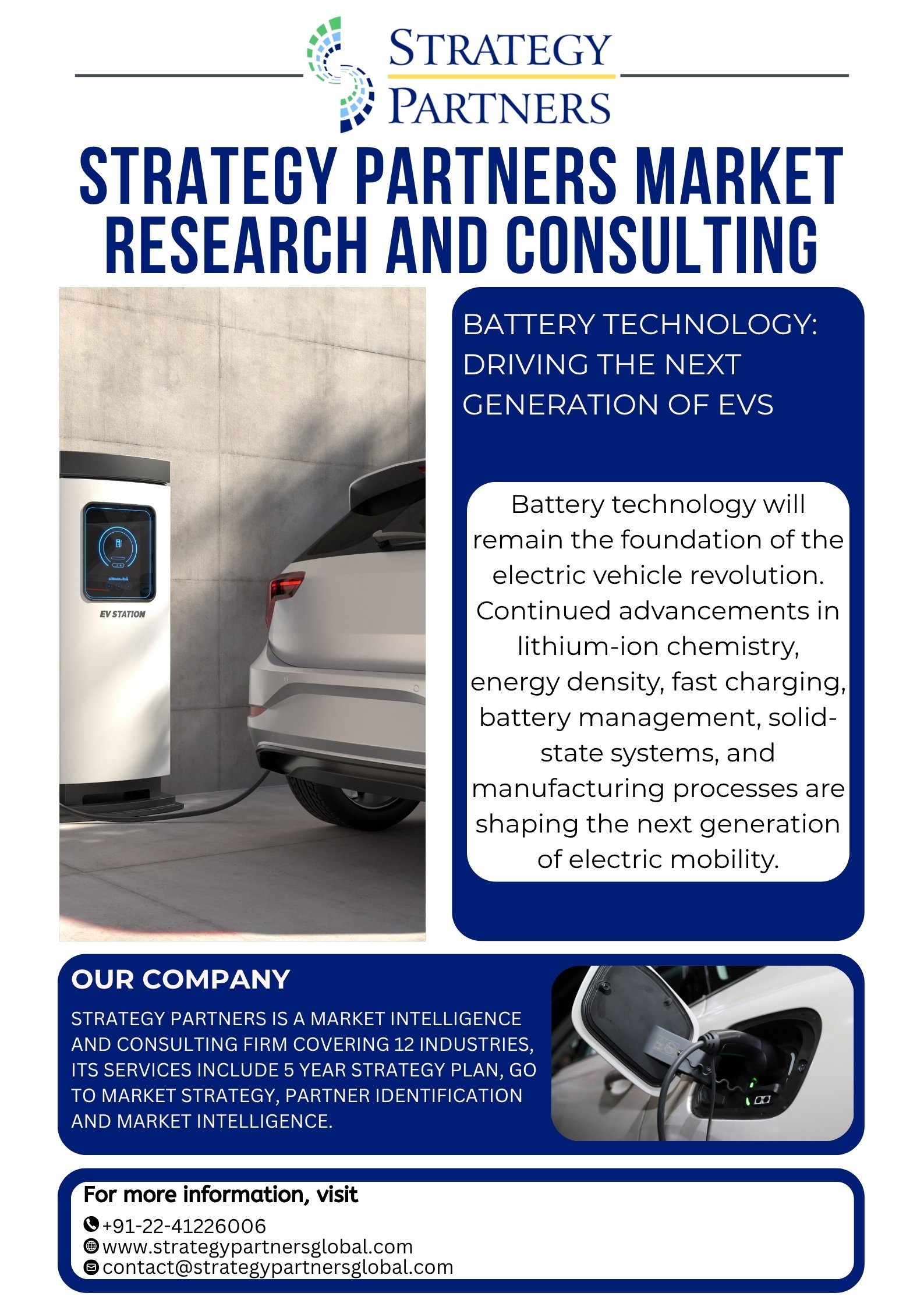
Battery technology will remain the foundation of the electric vehicle revolution. Continued advancements in lithium-ion chemistry, energy density, fast charging, battery management, solid-state systems, and manufacturing processes are shaping the next generation of electric mobility.
The future EVs battery will need to deliver more than just greater range. It must be safer, lighter, faster to charge, longer lasting, and more affordable. At the same time, improvements in recycling and material recovery will be essential for creating a more sustainable battery ecosystem.
As battery technology continues to evolve, it will enable EVs to become increasingly practical and accessible. These advancements will not only improve passenger cars but will also support the electrification of commercial vehicles and other transportation sectors. Ultimately, the continued development of advanced battery systems will play a decisive role in driving the next generation of electric vehicles and the broader transition toward cleaner, more efficient mobility.