Artificial intelligence is transforming quality control across the precision manufacturing industry by enabling manufacturers to detect defects, monitor production processes, analyze complex data, and improve product consistency. Precision manufacturing requires extremely tight tolerances, accurate dimensions, high-quality surface finishes, and reliable material properties. Even minor deviations can affect the performance, safety, and lifecycle of components used in aerospace, defense, automotive, medical, semiconductor, and industrial applications.
Traditional quality inspection methods often depend on manual measurements, sampling, and operator experience. While these approaches remain valuable, manufacturers are increasingly combining them with artificial intelligence, machine vision, sensors, automation, and advanced metrology. AI-driven quality control can analyze production data continuously and identify patterns that may not be immediately visible to human inspectors.
As manufacturers move toward smart factories and Industry 4.0 environments, AI is becoming an important technology for improving quality, reducing production waste, and supporting predictive manufacturing.
Role of AI in Precision Manufacturing
AI-driven quality control uses machine learning algorithms and advanced data analytics to evaluate information collected throughout the manufacturing process. Data can come from CNC machines, coordinate measuring machines, optical inspection systems, cameras, laser scanners, sensors, and production management systems.
Machine learning models can be trained using historical production and inspection data to identify relationships between manufacturing parameters and product quality. Once deployed, these systems can continuously evaluate new data and identify deviations from expected conditions.
This approach moves quality control beyond simply identifying defective components after production. AI can help manufacturers understand why defects occur and potentially detect early warning signs before a component fails inspection.
AI-Powered Machine Vision Inspection
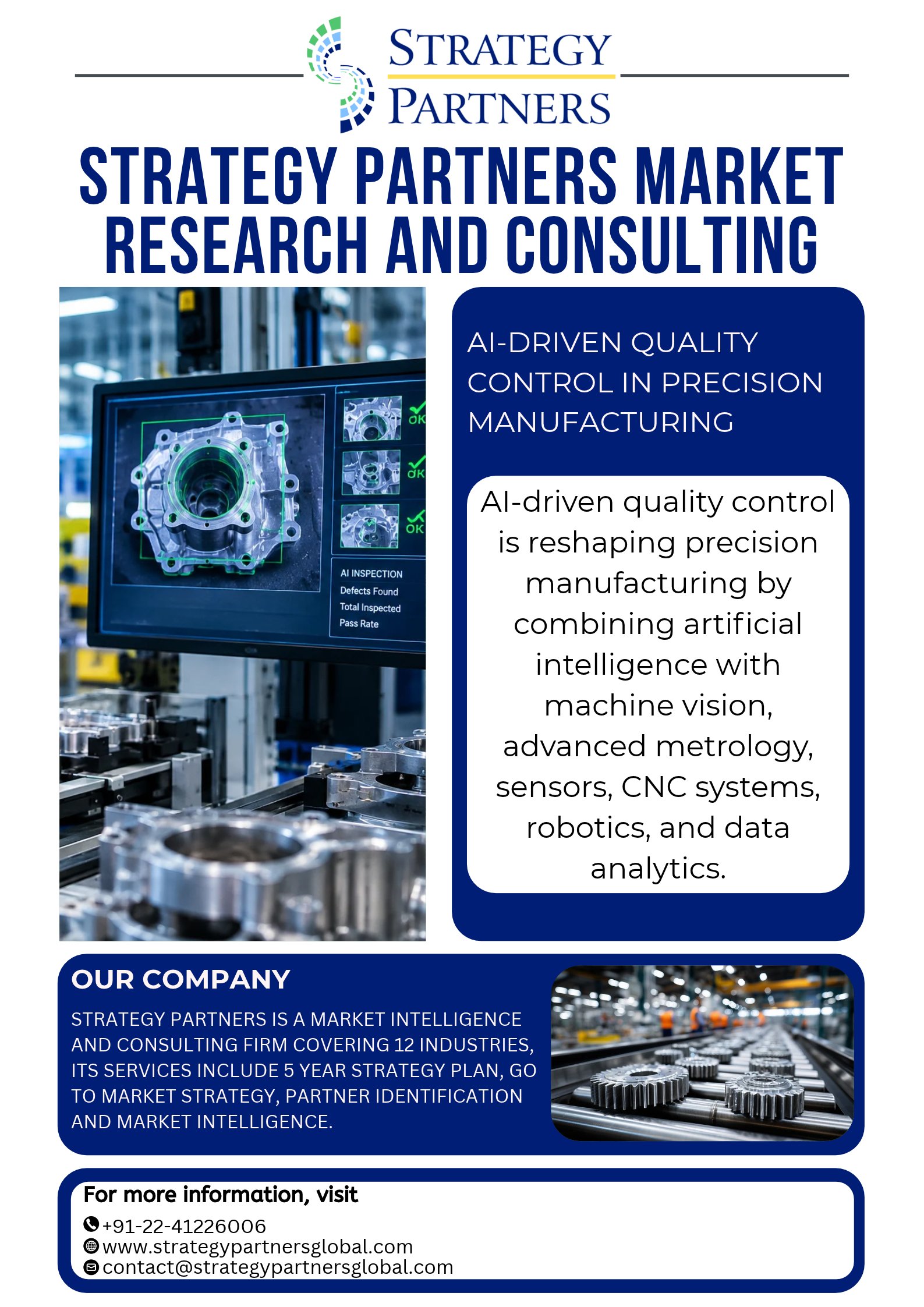
Machine vision is one of the most widely applicable technologies in AI-driven quality control. High-resolution cameras and imaging systems can inspect components for dimensional inconsistencies, surface defects, scratches, cracks, burrs, tool marks, incorrect assembly, and other abnormalities.
AI-powered vision systems can analyze images using deep learning algorithms trained to recognize acceptable and defective components. Unlike conventional rule-based inspection, AI systems can learn from large datasets and become more capable of identifying complex visual patterns.
For precision engineering companies, automated machine vision can provide faster and more consistent inspection while reducing dependence on manual visual inspection. It can also support 100% inspection for selected production lines where inspecting every component is economically or operationally practical.
AI and Advanced Metrology
Metrology is essential for precision manufacturing because components often need to meet extremely tight dimensional and geometric tolerances. Coordinate measuring machines, laser scanners, optical measurement systems, and other metrology equipment generate large quantities of dimensional data.
AI can analyze this information to identify recurring deviations and correlations between manufacturing conditions and dimensional accuracy. For example, quality teams can examine whether temperature, tool wear, machine vibration, cutting conditions, or other variables are contributing to dimensional variation.
Combining AI with advanced metrology can therefore create a more proactive quality management process. Instead of simply recording measurement results, manufacturers can use the data to identify potential sources of variation and improve process stability.
Predictive Quality Control and Machine Monitoring
One of the major advantages of AI is its ability to support predictive quality control. Manufacturing equipment generates continuous data related to temperature, vibration, spindle performance, cutting forces, tool condition, and other operating parameters.
AI models can identify patterns associated with tool degradation, machine instability, or process variation. This information can alert production teams before these conditions result in large numbers of defective components.
For CNC machining operations, predictive quality control can be particularly valuable. Tool wear can gradually affect dimensions and surface finish. By analyzing machine and inspection data, AI systems can help determine when tools are approaching conditions that could affect component quality.
This can reduce scrap, minimize unplanned downtime, and improve overall equipment utilization.
Digital Twins and AI-Based Quality Optimization
Digital twins are also becoming increasingly relevant to AI-driven manufacturing. A digital twin is a digital representation of a physical machine, production process, or component that can be updated using real-world data.
When combined with AI, digital twins can simulate production conditions, identify potential process problems, and evaluate the effects of changing manufacturing parameters.
For precision manufacturing, this can support process optimization before changes are implemented on the production floor. Manufacturers can use digital models to investigate potential sources of dimensional variation, optimize machining parameters, and improve production consistency.
Benefits of AI-Driven Quality Control
AI-driven quality control can provide several benefits across precision manufacturing operations. Improved accuracy is one of the most important advantages because AI systems can analyze large quantities of inspection data consistently.
Reduced scrap and rework can result from earlier identification of process deviations. Detecting problems before large production batches are completed can significantly reduce material waste and manufacturing costs.
Faster inspection is another advantage. Automated vision and measurement systems can process components rapidly, helping manufacturers maintain production throughput without compromising quality.
AI can also support predictive maintenance and process optimization by identifying relationships between machine conditions and product quality. This can help manufacturers move from reactive quality management toward continuous process improvement.
Applications Across Key Industries
AI-driven quality control is particularly important in industries where component reliability and dimensional accuracy are critical.
In aerospace and defense manufacturing, AI can support the inspection of aircraft structural components, engine parts, precision machined components, and complex assemblies. Strict quality requirements make automated inspection and traceability particularly valuable.
In the automotive industry, AI can inspect engine components, transmission parts, electric vehicle components, and other precision-manufactured products.
The medical device industry can use AI-assisted inspection for components and devices where dimensional accuracy, surface quality, and manufacturing consistency are essential.
In semiconductor manufacturing, advanced inspection and defect detection technologies are increasingly important because manufacturing processes operate at extremely small scales.
Industrial machinery, energy equipment, electronics, and precision tooling are also expected to benefit from AI-based quality management.
Challenges in AI-Based Quality Control
Despite its advantages, implementing AI-driven quality control presents several challenges. One of the biggest is the availability of high-quality data. Machine learning models require representative datasets containing sufficient examples of both acceptable and defective components.
Integration with existing manufacturing equipment can also be difficult. Older CNC machines and inspection systems may not have the connectivity required for real-time data collection.
Initial investment in cameras, sensors, software, computing infrastructure, and integration can also be significant, particularly for small and medium-sized manufacturers.
Another challenge is workforce readiness. Employees need training to operate AI-enabled inspection systems, interpret analytical results, and respond appropriately to system alerts. Human expertise therefore remains an important part of AI-supported quality control.
Future Trends in AI-Driven Quality Control
The future of AI-driven quality control will increasingly involve connected inspection systems, real-time analytics, edge computing, digital twins, and autonomous process optimization. AI systems will increasingly analyze data directly at the manufacturing site, allowing faster responses to quality deviations.
The combination of AI, robotics, machine vision, and advanced metrology could enable highly automated inspection cells where components are measured, classified, and documented with minimal manual intervention.
Generative AI may also support quality engineering by helping teams analyze inspection reports, summarize production trends, identify recurring issues, and assist with technical documentation. Meanwhile, machine learning models will continue improving predictive capabilities as manufacturers collect larger datasets.
Another important trend will be the integration of quality data across the entire manufacturing lifecycle. Instead of treating inspection as a final production step, manufacturers will increasingly connect design, machining, measurement, maintenance, and supply-chain data to create a continuous quality feedback loop.
Conclusion
AI-driven quality control is reshaping precision manufacturing by combining artificial intelligence with machine vision, advanced metrology, sensors, CNC systems, robotics, and data analytics. The technology enables manufacturers to detect defects more efficiently, identify process deviations earlier, reduce scrap, and improve production consistency.
As aerospace, defense, automotive, medical, semiconductor, and industrial manufacturers demand increasingly precise components, intelligent quality systems will become more important. The transition from manual and sampling-based inspection toward continuous, predictive, and automated quality management represents a major step in the development of smart manufacturing.
In the coming years, AI-driven quality control is expected to become a key component of precision engineering, helping manufacturers achieve higher accuracy, greater efficiency, improved traceability, and more reliable production outcomes.