Artificial intelligence (AI) is transforming logistics by helping businesses manage increasingly complex supply chains with greater speed, visibility, and precision. From demand forecasting and inventory management to warehouse automation, route optimization, and last-mile delivery, AI-powered technologies are being integrated across multiple stages of the logistics process. As global supply chains face changing customer expectations, transportation disruptions, labor constraints, and growing operational costs, AI provides organizations with tools to make faster, data-driven decisions.
Traditional logistics operations often depend on historical information, manual planning, fixed transportation schedules, and human decision-making. While these approaches remain important, they can struggle to respond quickly when demand changes, shipments are delayed, inventory levels fluctuate, or transportation conditions change. AI can continuously analyze large volumes of structured and unstructured data, identify patterns, and generate insights that support real-time operational decisions.
The growth of cloud computing, Internet of Things (IoT) devices, advanced analytics, robotics, and connected transportation systems is further strengthening AI adoption. Together, these technologies are creating increasingly intelligent logistics networks capable of predicting disruptions, optimizing resources, and improving supply-chain visibility.
How AI Is Transforming Logistics
One of the most important applications of AI in logistics is demand forecasting. Companies need accurate forecasts to determine how much inventory should be stored, where it should be positioned, and when replenishment should occur. Conventional forecasting methods can struggle when demand is influenced by seasonal changes, market conditions, promotions, weather, or unexpected events.
AI algorithms can analyze historical sales, customer behavior, market trends, seasonal patterns, and other variables to identify demand signals. Machine learning models can continuously learn from new data and refine forecasts. More accurate predictions can help organizations reduce excess inventory while lowering the risk of stockouts.
Inventory management is another area experiencing significant transformation. AI-powered systems can monitor inventory levels across warehouses and distribution centers while identifying products that may require replenishment. Intelligent inventory platforms can recommend optimal stock levels based on predicted demand, lead times, supplier performance, and storage capacity.
AI also supports transportation optimization. Logistics providers manage numerous variables, including vehicle availability, delivery schedules, fuel consumption, traffic conditions, weather, road restrictions, and customer requirements. AI-based route optimization systems can evaluate these variables and identify efficient transportation plans. When conditions change, algorithms can adjust routes and schedules to minimize delays and improve fleet utilization.
AI in Warehousing and Transportation
Warehouses are becoming increasingly automated through the combination of AI, robotics, computer vision, and IoT technologies. AI-powered warehouse management systems can analyze incoming orders and determine how products should be stored, picked, packed, and dispatched.
Robotic systems can perform repetitive activities such as transporting goods between storage and packing areas. Computer vision can help identify products, inspect packages, monitor inventory, and detect potential handling errors. AI algorithms can coordinate these activities to improve warehouse throughput and reduce unnecessary movement.
Predictive maintenance is another important application. Logistics companies depend heavily on vehicles, conveyor systems, forklifts, sorting machines, refrigeration equipment, and other assets. Equipment failures can disrupt operations and increase maintenance expenses. AI systems can analyze sensor data, operating conditions, vibration, temperature, and historical maintenance records to identify early signs of equipment deterioration.
In transportation fleets, predictive maintenance can help identify vehicles that may require servicing before a major failure occurs. This can support higher fleet availability and reduce unexpected downtime.
AI is also influencing autonomous transportation. Autonomous trucks, delivery robots, and other automated mobility systems are being developed to perform specific logistics tasks with reduced human intervention. Although widespread deployment depends on regulatory, technological, safety, and infrastructure considerations, automation is expected to remain an important area of logistics innovation.
AI-Powered Last-Mile Delivery
Last-mile delivery is one of the most challenging stages of the supply chain because it involves delivering individual orders to numerous destinations within specific time windows. Traffic congestion, failed deliveries, changing customer availability, and high operating costs can make last-mile logistics particularly complex.
AI can improve last-mile operations by analyzing delivery addresses, traffic patterns, vehicle capacity, delivery windows, and driver availability. Dynamic routing systems can adjust delivery sequences based on real-time conditions.
AI-powered customer communication can also improve delivery experiences. Intelligent systems can provide estimated arrival times, automatically update customers about delays, and respond to routine delivery-related questions through conversational AI.
Delivery drones and autonomous ground vehicles represent another emerging application. These systems could support deliveries in selected environments, particularly where rapid transportation or access to difficult locations is required. Their broader adoption will depend on infrastructure, regulations, safety requirements, and economic viability.
AI for Supply Chain Visibility and Risk Management
Supply-chain visibility has become increasingly important as companies operate across geographically distributed supplier, manufacturing, transportation, and distribution networks. A disruption at one point can affect multiple downstream operations.
AI can combine data from suppliers, transportation systems, warehouses, IoT sensors, enterprise platforms, and external information sources to create a more comprehensive view of supply-chain activity. Algorithms can identify unusual patterns and potential disruptions, enabling organizations to investigate issues earlier.
Risk management is another growing application. AI models can assess historical disruptions and monitor variables that may affect logistics performance. These can include transportation delays, supplier reliability, demand fluctuations, weather conditions, and capacity constraints.
Instead of responding only after a disruption occurs, companies can use predictive analytics to evaluate possible scenarios and develop alternative plans. This approach can support more resilient supply chains and improve business continuity.
Benefits and Challenges of AI-Powered Logistics
AI adoption can provide several operational benefits. Improved forecasting can support better inventory planning, while route optimization can reduce unnecessary transportation time and resource consumption. Automation can increase warehouse productivity, and predictive maintenance can help reduce unexpected equipment downtime.
AI can also improve decision-making by allowing logistics managers to analyze large quantities of information more rapidly. Real-time data can provide greater visibility into shipments, inventory, vehicle locations, and operational performance.
However, implementing AI also presents challenges. High-quality data is essential because inaccurate, incomplete, or inconsistent information can reduce the reliability of AI-generated insights. Organizations may also need to integrate AI platforms with existing enterprise resource planning, warehouse management, transportation management, and fleet-management systems.
Cybersecurity and data privacy are additional considerations. Connected logistics systems generate and exchange substantial quantities of operational information. Organizations therefore need appropriate security controls to protect systems and data from unauthorized access.
Workforce transformation is another important factor. AI and automation may change the nature of logistics jobs by reducing certain repetitive activities while increasing demand for employees with skills in technology management, data analysis, robotics, maintenance, and system supervision. Successful adoption therefore requires training and workforce development.
Future Outlook for AI in Logistics
The future of AI-powered logistics will likely involve deeper integration between artificial intelligence, IoT, robotics, digital twins, cloud computing, autonomous systems, and advanced analytics. Logistics networks are expected to become increasingly connected, allowing organizations to move from reactive operations toward predictive and more automated decision-making.
Digital twins could enable companies to create virtual representations of warehouses, transportation networks, or entire supply chains. AI can analyze these digital environments to simulate potential changes and evaluate different operational scenarios before implementing them in the physical world.
Generative AI is also emerging as a potential tool for logistics management. It can assist with analyzing operational information, generating reports, supporting customer service, summarizing disruptions, and helping employees interact with complex supply-chain data through natural-language interfaces.
As these technologies mature, AI will increasingly become an integrated component of supply-chain management rather than a standalone technology. Companies that combine reliable data infrastructure with intelligent automation can improve visibility, responsiveness, and operational efficiency.
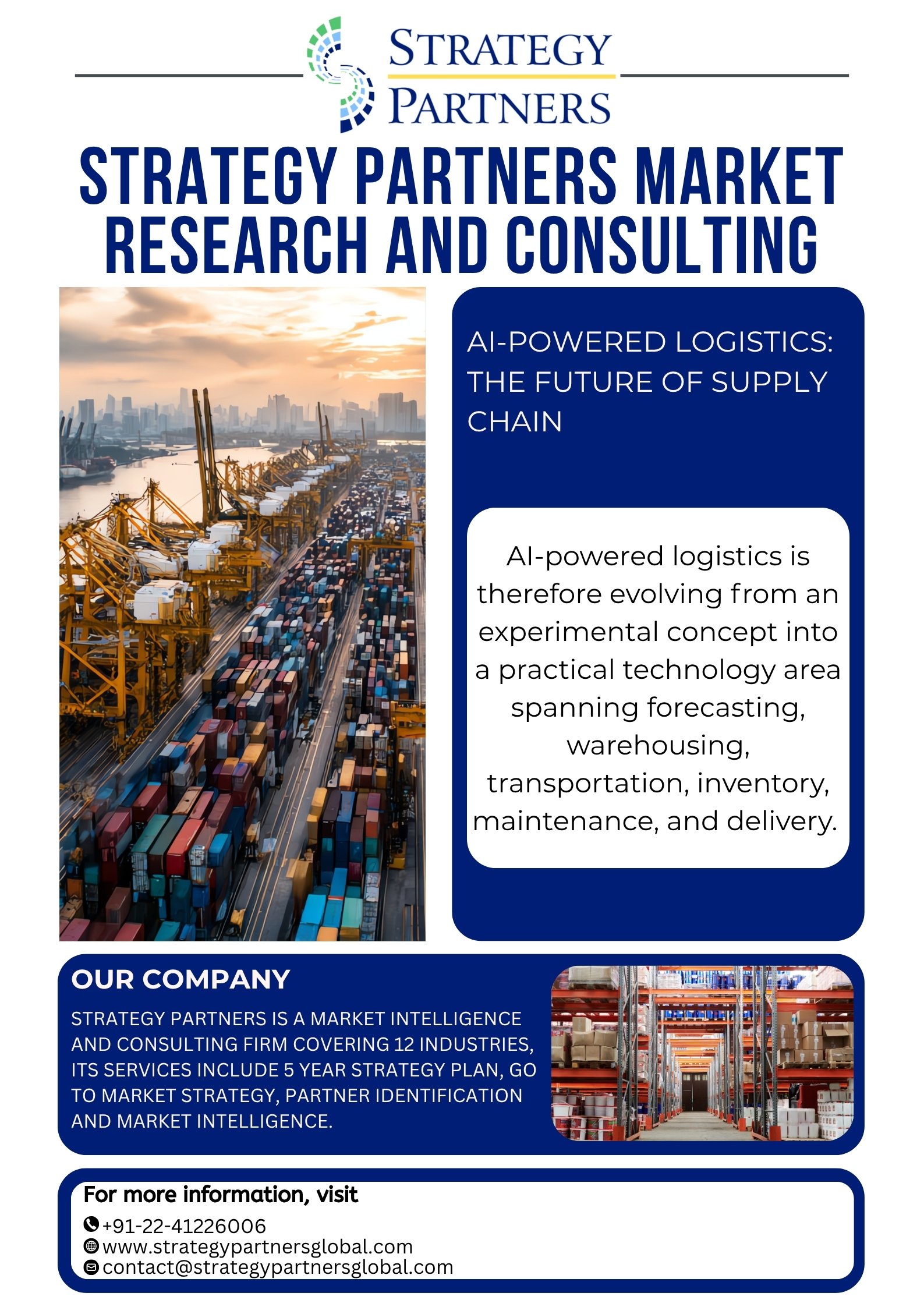
AI-powered logistics is therefore evolving from an experimental concept into a practical technology area spanning forecasting, warehousing, transportation, inventory, maintenance, and delivery. Continued advances in AI algorithms, connected devices, robotics, and computing infrastructure are expected to expand its role across the logistics industry, supporting more responsive and data-driven supply chains.