Precision engineering is becoming a cornerstone of next-generation manufacturing as industries demand components that deliver higher accuracy, reliability, durability, and performance. From aerospace and defense to automotive, medical devices, electronics, energy, and industrial machinery, manufacturers increasingly depend on precision-engineered components to improve product quality and meet demanding operational requirements.
The rapid development of advanced manufacturing technologies is transforming how these components are designed, produced, inspected, and integrated into complex systems. Computer-aided design, computer numerical control machining, additive manufacturing, robotics, automation, digital twins, artificial intelligence, and advanced metrology are enabling manufacturers to achieve tighter tolerances while improving productivity and reducing material waste.
Understanding Precision Engineering
Precision engineering involves the design and manufacture of components and systems according to highly accurate dimensional, geometric, and performance specifications. Unlike conventional manufacturing, where standard tolerances may be sufficient, precision engineering focuses on achieving extremely consistent dimensions and surface characteristics.
Precision components can include gears, shafts, bearings, valves, fasteners, brackets, housings, connectors, actuators, hydraulic components, and specialized mechanical assemblies. Their performance often depends on tolerances measured at the micron level, particularly in applications where even a small dimensional variation can affect safety, efficiency, or equipment reliability.
The process typically begins with detailed engineering design and material selection. Manufacturers then use specialized machining, forming, grinding, finishing, and inspection technologies to produce components according to precise specifications. Advanced measurement systems verify dimensional accuracy before components are integrated into larger assemblies.
Why Precision Engineering Matters in Modern Manufacturing
The growing complexity of modern products is one of the major factors increasing demand for precision engineering. Aerospace engines, electric vehicles, medical equipment, semiconductor manufacturing systems, satellites, industrial robots, and defense platforms contain thousands of components that must operate reliably under demanding conditions.
Precision-engineered components help manufacturers achieve improved product performance and longer operating life. Accurate components can reduce friction, vibration, wear, leakage, and mechanical failure. In automotive and aerospace applications, precision manufacturing can also contribute to weight reduction and improved fuel or energy efficiency.
Another major advantage is repeatability. Modern production environments require manufacturers to produce large volumes of components with consistent quality. CNC machining and automated production systems can replicate complex designs with limited variation, supporting high-volume manufacturing while maintaining strict quality standards.
Precision engineering also supports product miniaturization. As electronic, medical, and industrial products become smaller, manufacturers need increasingly compact components with sophisticated geometries. Advanced manufacturing technologies make it possible to produce these complex parts without compromising performance.
Technologies Transforming Precision Manufacturing
The evolution of precision engineering is closely connected to advancements in manufacturing technology. CNC machining remains one of the most important technologies because it enables automated production of components with complex geometries and tight tolerances. Multi-axis machining further expands manufacturing capabilities by allowing tools to approach workpieces from multiple directions.
Additive manufacturing is also creating new opportunities. Unlike traditional machining, which removes material from a workpiece, additive manufacturing builds components layer by layer. This approach can produce complex internal structures, lightweight designs, and customized components that may be difficult or expensive to manufacture using conventional processes.
Automation and robotics are improving production consistency while reducing dependence on repetitive manual operations. Robotic systems can handle material movement, machining processes, assembly, inspection, and other manufacturing tasks. When integrated with industrial software, these systems can create highly automated production environments.
Artificial intelligence and machine learning are emerging as important tools for process optimization. AI-powered systems can analyze production data, identify patterns, detect anomalies, and support predictive maintenance. Manufacturers can use these capabilities to identify potential quality problems before defective components reach later stages of production.
Digital twins are another significant development. A digital twin creates a virtual representation of a physical component, machine, or manufacturing process. Engineers can use digital models to simulate performance, identify design weaknesses, optimize production parameters, and monitor equipment throughout its operating life.
Advanced metrology is equally important. Coordinate measuring machines, laser scanners, optical measurement systems, and other inspection technologies allow manufacturers to verify extremely small dimensional variations. Automated inspection systems can also accelerate quality control while generating detailed production data.
Applications Across High-Value Industries
Aerospace and defense represent some of the most demanding markets for precision engineering. Aircraft engines, landing gear, flight-control systems, radar equipment, missile systems, satellites, and unmanned platforms require components manufactured to stringent specifications. Reliability is particularly important because component failure in these applications can have significant operational consequences.
The automotive industry is also rapidly increasing its use of precision components. Electric vehicles require accurately manufactured motors, gearboxes, battery-related components, thermal-management systems, and electronic assemblies. At the same time, advanced driver-assistance systems and autonomous vehicle technologies are creating demand for highly precise sensors, actuators, and mechanical components.
Medical technology represents another important application area. Surgical instruments, implants, diagnostic equipment, robotic surgical systems, and medical devices often require extremely accurate components. Precision manufacturing enables manufacturers to produce miniature and complex parts while meeting strict quality and regulatory requirements.
In semiconductor manufacturing, precision is critical because production equipment operates at extremely small scales. Components used in wafer processing, lithography, inspection, and material handling must maintain high dimensional accuracy and stability.
Energy, telecommunications, industrial automation, marine systems, and space technologies are also benefiting from advances in precision engineering. As industrial equipment becomes more automated and sophisticated, the requirement for accurate and reliable components is expected to continue increasing.
Sustainability and Smart Manufacturing
Precision engineering is also contributing to more sustainable manufacturing. Improved machining accuracy can reduce scrap, rework, and unnecessary material consumption. Advanced production software can optimize tool paths and machining parameters, helping manufacturers use raw materials and energy more efficiently.
The integration of smart manufacturing technologies is further strengthening this trend. Connected machines can collect real-time information about production performance, tool wear, energy consumption, and component quality. Manufacturers can analyze this information to improve processes and reduce downtime.
Predictive maintenance can extend equipment life by identifying potential failures before they result in major breakdowns. Similarly, automated quality inspection can reduce defective production and minimize the resources required for reprocessing.
Challenges and Future Outlook
Despite its advantages, precision engineering faces several challenges. High-precision equipment can require significant capital investment, while advanced machining and inspection systems require skilled engineers and technicians. Manufacturers must also manage increasingly complex supply chains and ensure consistent availability of specialized materials and tools.
The shortage of highly skilled technical personnel is another important concern. Precision manufacturing requires expertise in engineering design, CNC programming, metrology, materials science, automation, and quality management. Investment in technical training and workforce development will therefore remain essential.
Looking ahead, precision engineering is expected to become increasingly digital, automated, connected, and intelligent. AI-driven process optimization, robotics, additive manufacturing, advanced sensors, digital twins, and automated inspection will continue to reshape production environments.
The convergence of engineering expertise with digital technologies will allow manufacturers to move beyond simply producing accurate components toward creating intelligent and highly optimized manufacturing systems. Companies that invest in advanced precision capabilities can improve product quality, shorten development cycles, reduce waste, and strengthen their competitiveness.
Conclusion
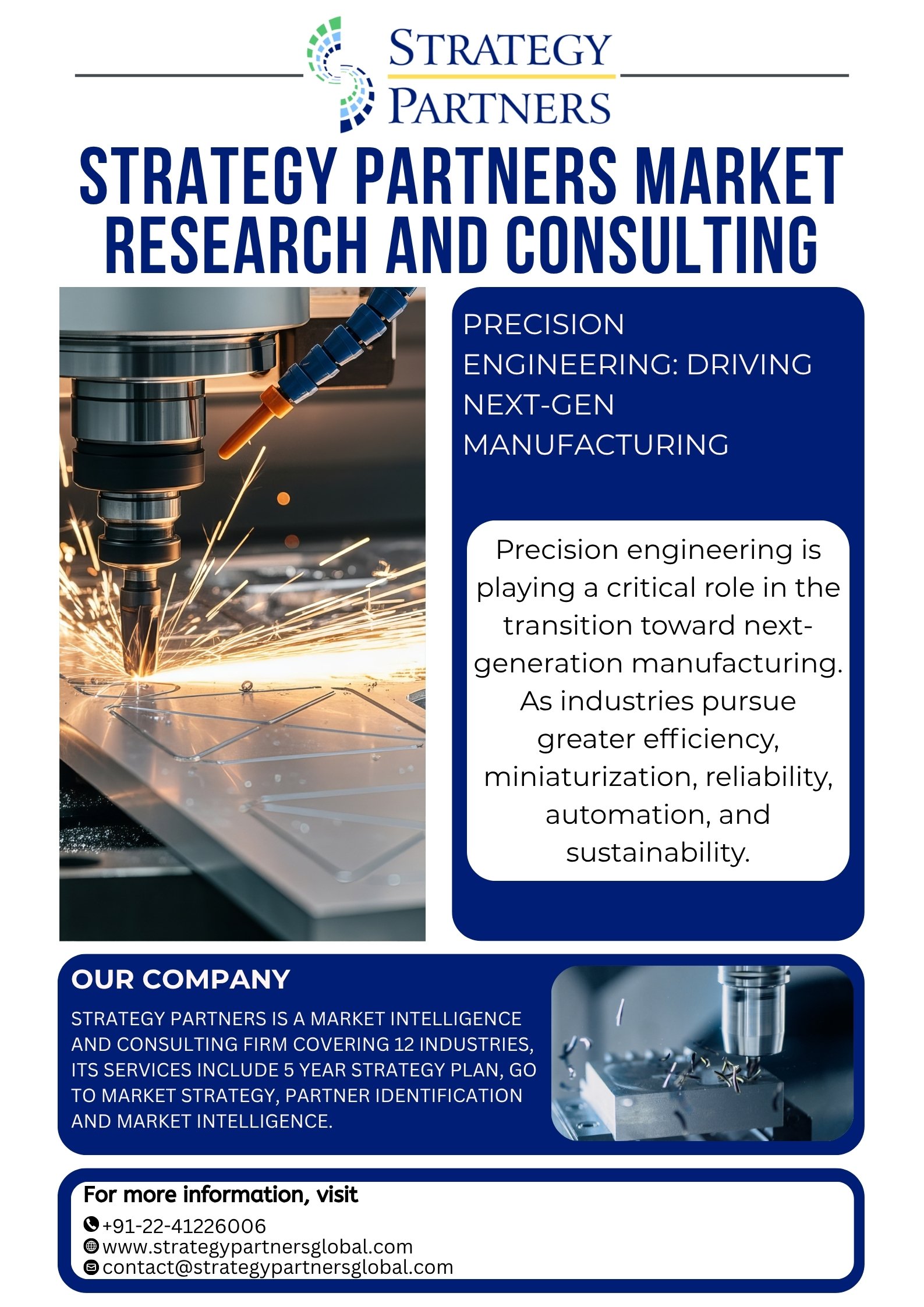
Precision engineering is playing a critical role in the transition toward next-generation manufacturing. As industries pursue greater efficiency, miniaturization, reliability, automation, and sustainability, the demand for accurately manufactured components will continue to grow.
From aerospace and automotive systems to medical devices, electronics, defense platforms, and industrial machinery, precision components form the foundation of many advanced products. With the continued adoption of CNC machining, additive manufacturing, robotics, artificial intelligence, digital twins, and advanced metrology, precision engineering is evolving into a smarter and more connected manufacturing discipline.
Ultimately, precision engineering is not simply about achieving tighter tolerances. It is about enabling manufacturers to build better-performing products, optimize production processes, reduce resource consumption, and prepare for an increasingly technology-driven industrial future.