India’s manufacturing sector is evolving rapidly, and precision engineering has become one of its most important pillars. Precision engineering involves designing and manufacturing components with extremely tight tolerances and high accuracy. These components are essential for industries where even the smallest measurement error can affect performance, safety, or reliability. As India strengthens its position as a global manufacturing hub, the demand for precision-engineered products continues to grow across aerospace, defence, automotive, medical devices, electronics, energy, and industrial machinery.
The Indian government’s focus on initiatives such as Make in India, Atmanirbhar Bharat, and the Production Linked Incentive (PLI) scheme has further accelerated investments in advanced manufacturing. Companies are adopting modern machining technologies, automation, robotics, and digital manufacturing to improve productivity and meet international quality standards. As a result, the precision engineering market in India is witnessing significant expansion and attracting both domestic and foreign investments.
Understanding Precision Engineering
Precision engineering refers to the production of components and systems with exceptionally high dimensional accuracy and repeatability. Manufacturers use advanced machining processes such as CNC milling, CNC turning, grinding, electrical discharge machining (EDM), laser cutting, waterjet cutting, and additive manufacturing to produce complex parts.
These components often serve critical applications where precision is essential. Aircraft engines, missile guidance systems, medical implants, semiconductor equipment, industrial robots, and electric vehicle components all rely on precision engineering. The industry also emphasizes strict quality control, advanced metrology, and continuous process improvement to ensure every component meets exact specifications.
Market Drivers Fueling Growth
Several factors are driving the growth of India’s precision engineering market. One of the most important is the rapid expansion of the aerospace and defence sector. India continues to increase domestic production of fighter aircraft, helicopters, missiles, naval systems, and defence electronics. These programs require highly accurate mechanical components that meet demanding performance standards.
The automotive industry also contributes significantly to market growth. Electric vehicles, hybrid vehicles, and connected mobility solutions require precision-engineered gears, shafts, battery components, motor housings, and lightweight structural parts. As vehicle technologies become more advanced, manufacturers require tighter tolerances and better production consistency.
Additionally, India’s electronics manufacturing industry is expanding rapidly. The production of smartphones, consumer electronics, semiconductor packaging, and electronic assemblies requires miniature precision components manufactured with extremely high accuracy.
Medical technology represents another promising growth area. Precision engineering supports the production of surgical instruments, orthopedic implants, dental equipment, diagnostic devices, and robotic surgical systems. Rising healthcare investments and increasing medical device manufacturing in India continue to strengthen this segment.
Advanced Manufacturing Technologies
Technological innovation is transforming India’s precision engineering industry. Modern CNC machining centers now offer multi-axis machining capabilities that allow manufacturers to produce highly complex geometries in a single setup. This improves productivity while reducing manufacturing errors.
Automation has become another key trend. Robotic material handling systems, automated inspection equipment, and smart manufacturing cells increase efficiency and reduce dependence on manual operations. These technologies also improve consistency during large-scale production.
Artificial intelligence and machine learning are increasingly being integrated into manufacturing operations. Predictive maintenance systems monitor machine health and reduce unexpected downtime. AI-powered quality inspection systems identify microscopic defects that traditional inspection methods may overlook.
Digital twins and Industry 4.0 technologies are enabling manufacturers to simulate production processes before actual manufacturing begins. This reduces design errors, optimizes machining strategies, and minimizes production costs.
Additive manufacturing, commonly known as industrial 3D printing, has also gained importance. Manufacturers now produce complex prototypes, customized tooling, and lightweight metal components more efficiently than conventional manufacturing methods.
Growing Role in Aerospace and Defence
The aerospace and defence industry remains one of the largest consumers of precision-engineered components in India. Aircraft structures, turbine blades, landing gear systems, missile components, radar assemblies, and satellite mechanisms require extremely tight manufacturing tolerances.
Government initiatives promoting indigenous defence manufacturing have encouraged Indian companies to develop advanced machining capabilities. Private manufacturers increasingly supply precision components to defence public sector undertakings, global aerospace companies, and international OEMs.
The rise of unmanned aerial vehicles, space exploration programs, and next-generation combat platforms further increases demand for high-quality precision manufacturing. Companies investing in AS9100 certification, advanced metrology, and aerospace-grade machining are strengthening India’s position in the global aerospace supply chain.
Opportunities Across Multiple Industries
Although aerospace and defence receive significant attention, precision engineering serves many other industries. Renewable energy companies require precision components for wind turbines, solar tracking systems, and hydrogen production equipment. Industrial automation companies need precision gears, actuators, linear motion systems, and robotic components.
The semiconductor industry also presents enormous opportunities. As India expands semiconductor fabrication and electronics manufacturing, demand for ultra-precision tooling, wafer handling equipment, and cleanroom-compatible components will continue to rise.
Railways, marine engineering, oil and gas, telecommunications, and heavy industrial equipment manufacturers are also increasing their investments in precision-engineered products to improve reliability and operational efficiency.
Challenges Facing the Industry
Despite strong growth potential, India’s precision engineering market faces several challenges. Skilled workforce availability remains a major concern. Operating advanced CNC machines, programming complex machining centers, and performing precision quality inspections require specialized technical expertise.
High capital investment is another challenge. Modern machining centers, coordinate measuring machines (CMMs), laser inspection systems, and automated manufacturing equipment require substantial financial resources. Small and medium-sized enterprises often struggle to invest in these advanced technologies.
Raw material quality also affects manufacturing precision. Manufacturers require consistent supplies of aerospace-grade alloys, specialty steels, titanium, aluminum, and engineering plastics that meet international standards.
Global competition continues to increase as manufacturers from Germany, Japan, South Korea, Taiwan, and China expand their capabilities. Indian companies must continuously improve productivity, quality, and delivery performance to remain competitive.
Future Outlook of the Precision Engineering Market in India
The future of India’s precision engineering market appears highly promising. Government policies supporting domestic manufacturing, defence modernization, electronics production, and infrastructure development will continue generating demand for precision components.
Industry 4.0 adoption will accelerate digital transformation across manufacturing facilities. Smart factories equipped with connected machines, artificial intelligence, cloud computing, and advanced analytics will improve productivity and product quality.
Sustainability will also influence future manufacturing practices. Companies are adopting energy-efficient machinery, reducing material waste, recycling cutting fluids, and implementing environmentally responsible manufacturing processes.
Export opportunities are expected to increase significantly as global companies diversify their supply chains beyond traditional manufacturing regions. Indian precision engineering firms that achieve international certifications and maintain world-class quality standards will benefit from growing global demand.
Conclusion
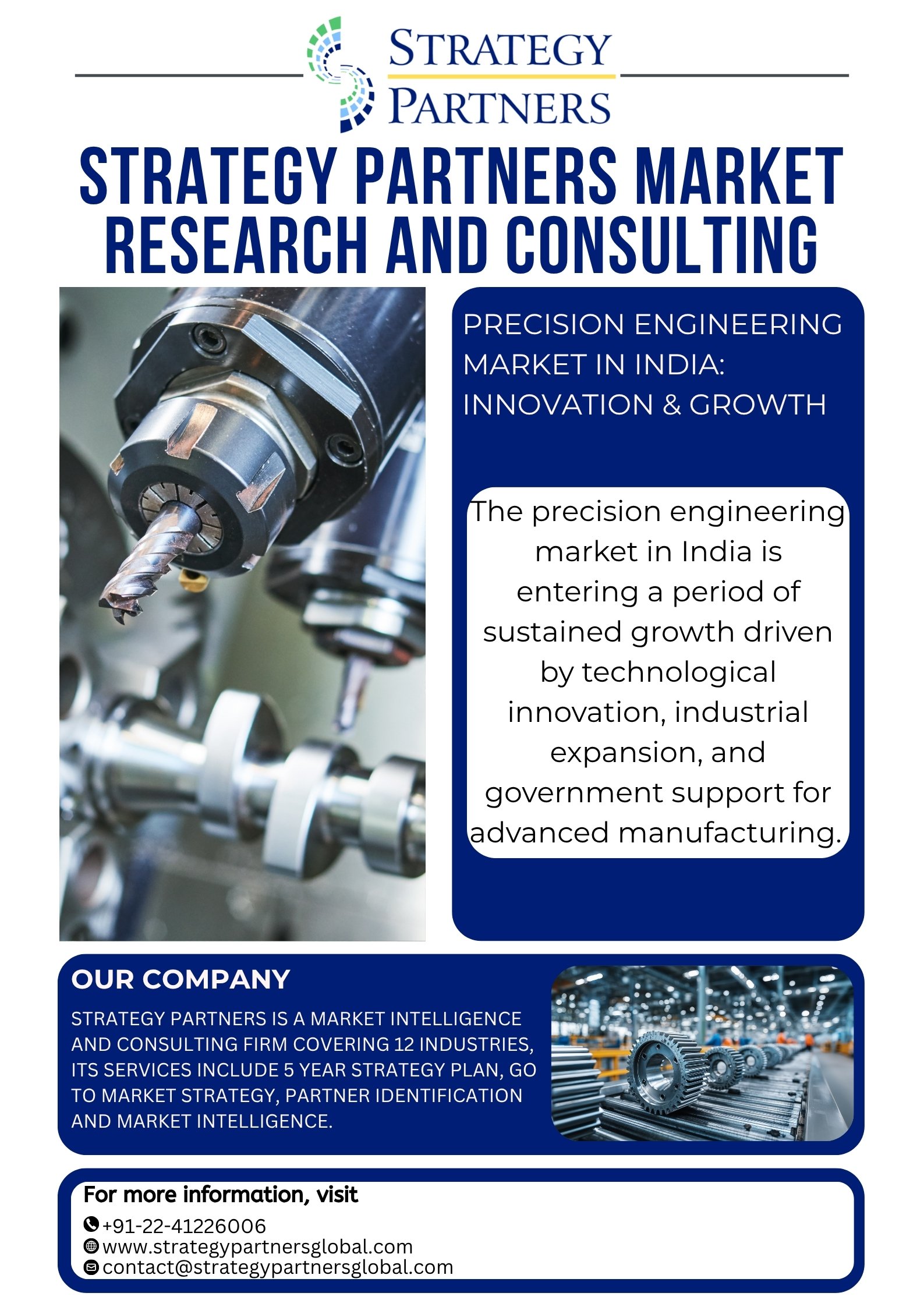
The precision engineering market in India is entering a period of sustained growth driven by technological innovation, industrial expansion, and government support for advanced manufacturing. Industries such as aerospace, defence, automotive, medical devices, electronics, renewable energy, and semiconductors increasingly rely on precision-engineered components to deliver high-performance products.
Continuous investments in automation, digital manufacturing, artificial intelligence, and advanced machining technologies are improving the competitiveness of Indian manufacturers. While challenges related to skilled labor, capital investment, and global competition remain, the industry’s long-term outlook remains highly positive.
As India continues its journey toward becoming a global manufacturing powerhouse, precision engineering will play a central role in strengthening industrial capabilities, enhancing export competitiveness, supporting technological self-reliance, and driving the next generation of innovation across multiple sectors.