Battery Recycling and Second-Life Applications in EVs
Strategic enablers are currently transforming battery recycling from limited pilots into a cornerstone of the circular economy. As a result, this shift is driving both resource efficiency and global supply chain resilience.
The Shift Toward Sustainability
Furthermore, rapid electrification brings growing concerns regarding resource efficiency and waste. Specifically, lithium-ion batteries contain valuable yet finite materials like lithium, cobalt, nickel, and manganese. Consequently, as global EV adoption accelerates, industry leaders are focusing more intensely on how to manage these batteries at the end of their automotive life.
In fact, rather than viewing recycling as a mere environmental necessity, companies now see it as a strategic tool to optimize costs and secure supply chains. Moreover, effective recovery frameworks maximize material reuse, which subsequently reduces dependency on virgin raw materials and enhances the overall lifecycle of electric vehicles.
Evolution of the Industry: Past, Present, and Future
The Experimental Past
In the early days, battery recycling remained limited and largely experimental. For instance, small market volumes meant that end-of-life batteries rarely justified large-scale infrastructure. Additionally, because recyclers often adapted systems from consumer electronics, they failed to optimize for the unique complexity of EV batteries. As a result, recovery rates stayed low, and processes focused primarily on safe disposal rather than extracting value.
The Scaling Present
Today, however, the landscape is shifting. Companies are now establishing dedicated recycling facilities using advanced hydrometallurgical and pyrometallurgical processes. This shift, in turn, allows manufacturers to reintroduce critical materials directly back into the supply chain.
Simultaneously, we are seeing a surge in “second-life” applications. While these batteries may no longer meet automotive standards, they nevertheless retain significant capacity for:
-
Grid balancing and renewable energy integration.
-
In addition to backup power systems for commercial use.
-
Finally, stationary energy storage solutions.
The Integrated Future
Looking ahead, recycling will become more technologically advanced and economically viable. For example, automation and digital tracking—such as “battery passports”—will allow for seamless material separation. Furthermore, manufacturers will likely design future batteries with modular architectures, thereby making them easier to disassemble from the start.
Strategic Market Drivers
Several key factors are accelerating the transition to a circular battery economy:
-
Regulatory Pressure: Governments are introducing stricter waste mandates. Consequently, recycling targets are becoming mandatory.
-
Resource Scarcity: Volatile prices for raw materials make recycled inputs more attractive. Therefore, material recovery aids price stability.
-
Environmental Impact: Consumer demand for “clean” technology pushes brands to reduce mining emissions. In response, companies are adopting greener lifecycles.
-
Cost Optimization: Extending an asset’s life through a second-life application creates new revenue streams. Thus, it enhances the overall business case.
Overcoming Industry Restraints
Despite the momentum, several hurdles remain that could slow progress:
-
High Capital Costs: Building advanced facilities requires significant investment. As a result, this can deter smaller players from entering the market.
-
Logistical Complexity: Collecting and transporting hazardous materials creates massive operational challenges. Furthermore, these issues are compounded when moving materials across borders.
-
Technical Variability: The lack of standardized battery chemistries makes it difficult to create universal processes. In other words, the “one-size-fits-all” approach is currently impossible.
-
Warranty Uncertainty: In second-life markets, concerns over long-term reliability can limit buyer confidence. Consequently, liability frameworks still need further development.
The Path Forward: Key Challenges
To fully realize a circular value chain, stakeholders must address the difficulty of accurately assessing a battery’s “State of Health” (SoH). In addition, we need better alignment between automakers, recyclers, and utilities to ensure incentives match up. Finally, as battery chemistry evolves rapidly, recycling infrastructure must stay flexible to avoid becoming obsolete.
Conclusion
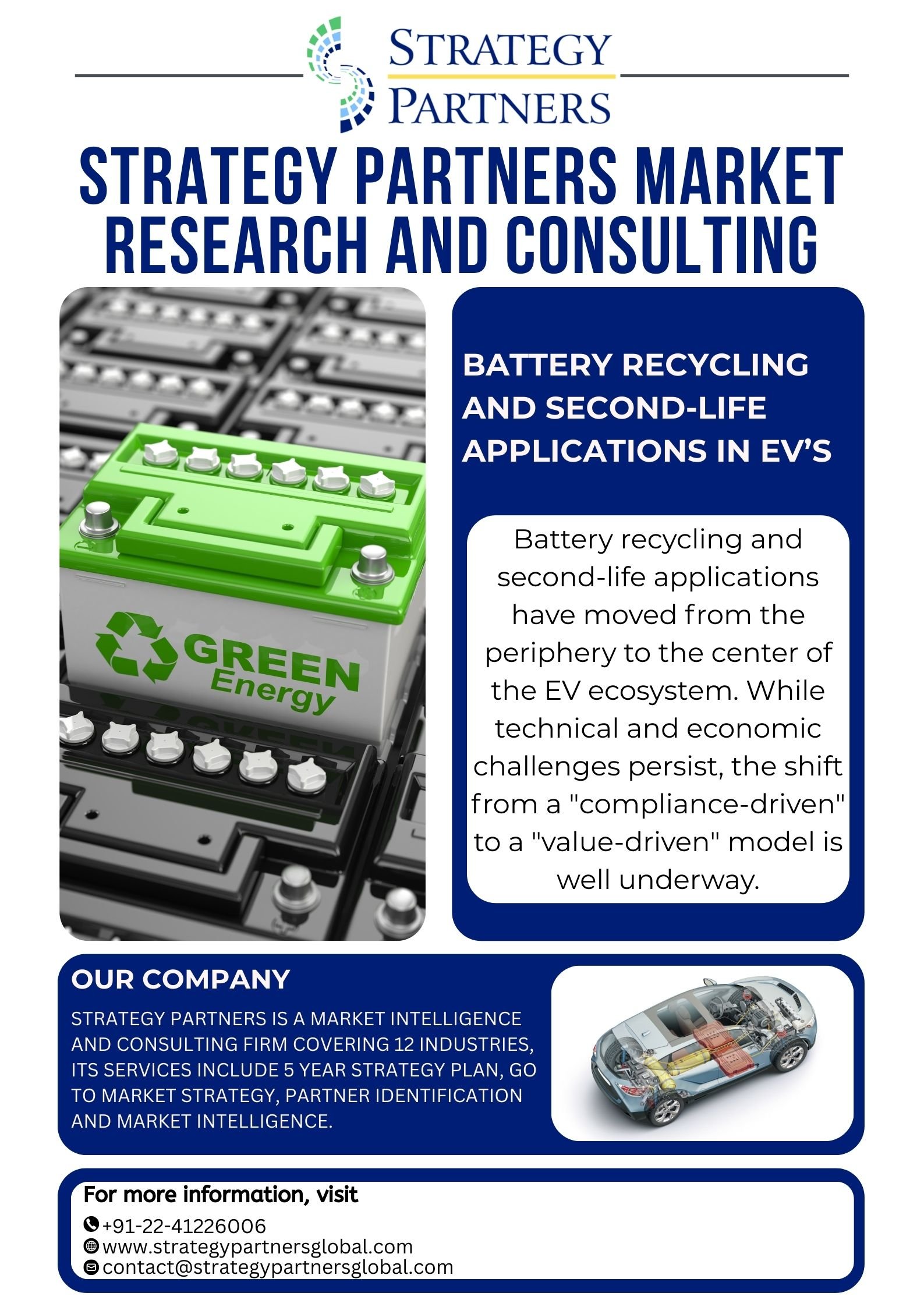
In summary, battery recycling and second-life applications have moved from the periphery to the center of the EV ecosystem. While technical and economic challenges persist, the shift from a “compliance-driven” to a “value-driven” model is well underway. Ultimately, by viewing the battery as a long-term asset rather than a disposable component, the industry can secure a more resilient and sustainable future for global mobility.