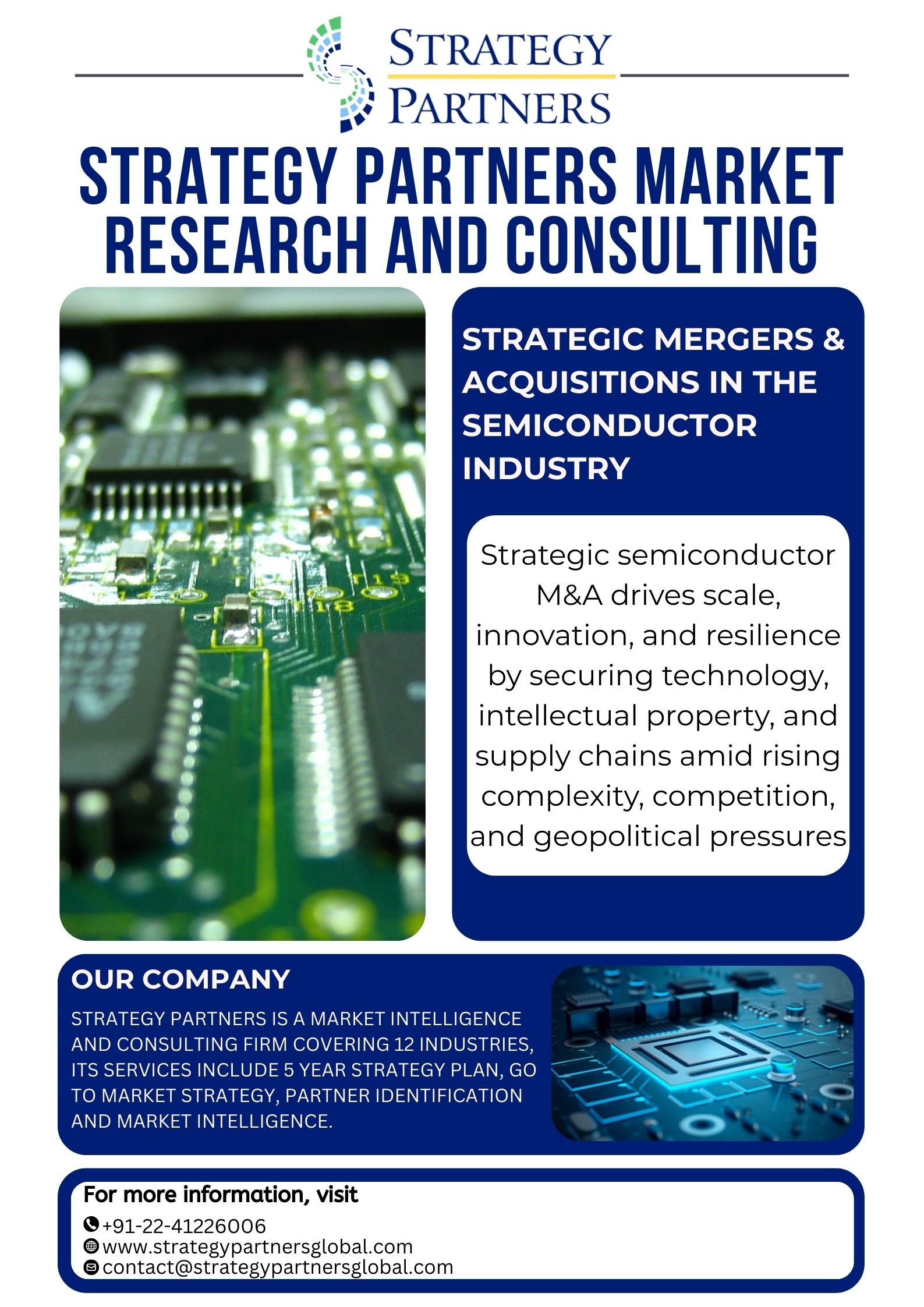
Strategic Mergers & Acquisitions in the Semiconductor Industry
Strategic semiconductor mergers and acquisitions (M&A) fundamentally drive scale and innovation. Specifically, they secure technology, intellectual property, and supply chains. Furthermore, this occurs despite rising complexity, fierce competition, and increasing geopolitical pressure.
Introduction
Undoubtedly, M&A plays a critical role in the semiconductor industry. Because this sector faces high costs, fast technology changes, and complex global supply chains, companies cannot rely solely on organic growth. Therefore, they rely on consolidation to expand. In particular, they use M&A to access new tech, reach more markets, and become stronger.
Moreover, chips are now essential for industries such as consumer electronics, cars, defense, and artificial intelligence (AI). Consequently, companies view M&A as a strategic tool rather than just a financial transaction. Ultimately, these deals accelerate innovation and help companies launch products faster.
Significantly, the reasons for M&A have changed over time. In the past, companies primarily wanted to cut costs. Conversely, today they need specific skills and supply chain security. Thus, understanding this evolution helps predict the industry’s future.
The Evolution of M&A
Past: Focus on Scale and Efficiency
Initially, in the early days of the industry, companies merged to achieve economies of scale. Since making chips is incredibly expensive, mergers helped spread these fixed costs across larger production volumes. For instance, companies acquired others to build more factories or enter new regions.
Additionally, vertical integration was a key driver. Specifically, companies wanted to control every step of the value chain, from design to testing. As a result, they bought design houses and equipment suppliers to improve operational control. During this time, technology differences were relatively small. Therefore, the main goals were market share and cost reduction. ** notably**, regulators rarely blocked these deals.
Present: Strategy and Capabilities
However, today the landscape is different. Currently, M&A is far more strategic. Because chips are increasingly complex, companies need advanced processes. Consequently, they do not just want to get bigger; they want specific intellectual property (IP) and differentiated design skills.
Furthermore, new markets like AI, self-driving cars, and cloud computing demand deep expertise. In response, companies now buy firms that specialize in graphics processing units (GPUs), AI accelerators, and power electronics. Simultaneously, they are acquiring software and IP companies to bridge the gap between hardware and software.
Moreover, geopolitics now matters more than ever. For example, national security concerns and export controls make cross-border deals significantly harder. In fact, governments actively watch these deals and offer incentives to keep production at home. As a result, deal-making has become slower and more difficult.
Future: Targeted Ecosystems
Looking ahead, M&A will remain vital. Nevertheless, companies will be more selective. Instead of pursuing broad growth, they will use acquisitions to fill specific capability gaps.
Specifically, advanced tech like AI, quantum computing, and new memory types will drive future deals. Therefore, companies will look for system-level capabilities. In particular, they will focus on advanced packaging and software-hardware integration. Additionally, sustainability will play a major role. Consequently, firms will look for energy-efficient designs and green manufacturing processes.
Finally, we will likely see more partnerships and joint ventures. These models share risk and help navigate regulations effectively. Furthermore, geopolitical issues may lead to more regional deals as nations try to secure their own supply chains.
Market Drivers and Restraints
Primary Growth Drivers
Several factors are actively accelerating M&A activity:
-
First, Rising Costs: Research and development (R&D) is expensive. Thus, buying a company is often faster and cheaper than building tech from scratch.
-
Second, Data Demand: Markets for AI and automotive electronics are booming. Accordingly, companies buy others to strengthen their product lines in these high-growth areas.
-
Third, Supply Chain Security: Firms want to reduce reliance on single suppliers. Therefore, M&A helps them secure manufacturing capacity and critical parts.
Key Restraints
Despite the benefits, several significant hurdles exist:
-
Regulation: Antitrust scrutiny is a major barrier. Frequently, regulators delay or block large, international deals due to national security concerns.
-
Valuation: Good chip companies cost a lot of money. Consequently, high prices increase financial risk.
-
Culture: Merging two different engineering cultures is hard. If employees clash, the company loses value.
Implementation Challenges
Undoubtedly, executing a successful deal is difficult. For instance, integrating complex manufacturing processes and product roadmaps takes time. Unfortunately, delays can destroy value rapidly in this fast-moving market.
Furthermore, retaining talent is critical. Since innovation relies on specialized engineers, the loss of key personnel after a merger is a major risk. If these people leave, the deal loses its strategic value. Finally, companies must manage geopolitical risks. Specifically, they must navigate trade rules and export controls while maintaining business continuity.
Conclusion
Ultimately, strategic M&A is a central pillar of growth for the semiconductor industry. While early deals focused on size, modern deals focus on skills, IP, and security.
Moving forward, companies will remain selective. However, they must navigate strict regulations and complex technology. In conclusion, success depends on smart deal selection and smooth integration. If done well, M&A remains a powerful tool for leadership in the global chip market.