
🛡️ Next-Gen Cybersecurity Market Trends
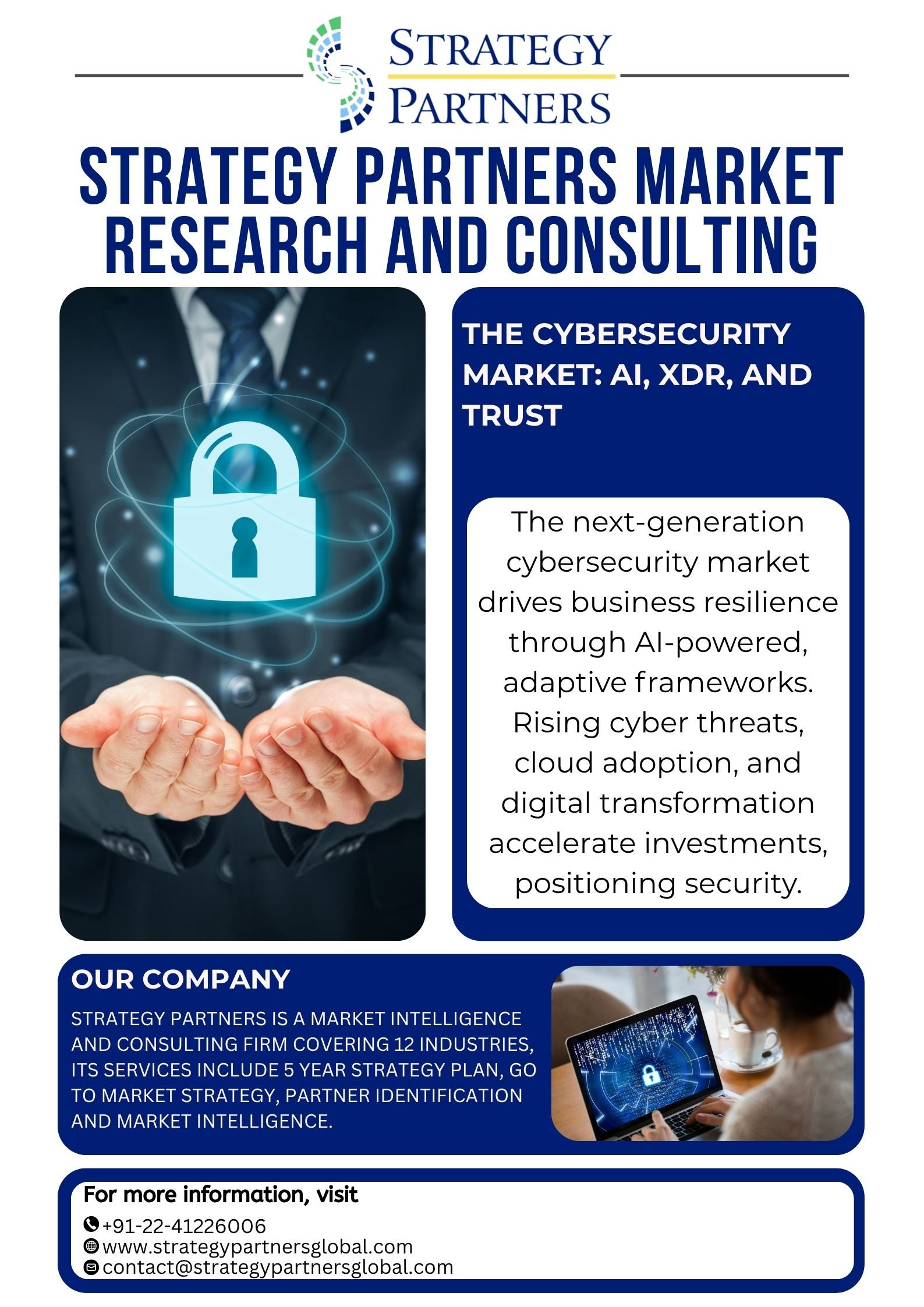
The next-generation cybersecurity market drives business resilience. Specifically, it uses AI-powered, adaptive frameworks. Rising cyber threats, cloud adoption, and digital transformation all accelerate investments. Consequently, this trend positions security as a strategic enabler of trust, efficiency, and competitive advantage.
1. Introduction: A Cornerstone of Resilience
The global market for next-generation cybersecurity solutions is a cornerstone of business resilience today. Escalating cyber threats, cloud migration, remote work models, and expanding attack surfaces prompted this change.
Therefore, organizations adopt advanced defense frameworks. For example, these include AI-driven detection, behavioral analytics, zero-trust architectures, and Extended Detection & Response (XDR). These new tools effectively safeguard digital ecosystems.
Both enterprises and public-sector organizations are revising strategies. Specifically, they budget to integrate proactive, adaptive security. The urgent need to mitigate data losses, reputational damage, and operational disruption drives market momentum.
The focus on automation, real-time threat intelligence, and integrated platforms is reshaping the vendor landscape. As digital transformation continues, next-gen cybersecurity emerges as a strategic investment—not just a cost. Ultimately, it ensures business continuity, trust, and innovation-enabled growth.
2. Past: From Perimeter to Proactive
Earlier years saw perimeter-based defenses dominate cybersecurity. These included signature-based malware protection and firewall/antivirus combinations. Legacy systems addressed common threats but proved inadequate once attacks became more sophisticated, persistent, and targeted.
For example, the expansion of cloud services, mobility, and IoT devices created new vulnerabilities. Consequently, traditional tools struggled to manage these risks. Many organizations simply bought point-solutions and hired more incident response staff.
The concept of “next-generation” security began to surface. Initial, experimental pilot deployments of behavioral analytics, sandboxing, and managed security services gained traction. During that time, awareness of Advanced Persistent Threats (APTs) increased. This, in turn, stimulated demand for proactive defenses.
Despite slower network speeds then, foundational work was underway. Specifically, this included data collection, threat-intelligence sharing, and incident management. Therefore, these efforts established prerequisites for the more integrated, intelligent frameworks we see today.
3. Present: Adoption and Integration
Currently, the next-generation cybersecurity market is advancing rapidly. Moreover, it is achieving broader adoption across all sectors. Organizations now leverage machine-learning algorithms, behavioral analytics, Identity and Access Management (IAM) tools, and zero-trust frameworks. They treat these as integral elements of their security programs.
Market size estimates suggest organizations are investing billions of dollars worldwide. Vendors differentiate themselves through cloud-native, converged platforms. These platforms, for instance, unify Endpoint Detection and Response (EDR), network monitoring, threat-intelligence feeds, and security orchestration.
Hybrid work environments, widespread use of IoT/OT systems, and regulatory pressure have driven this expansion. Organizations increasingly use real-time analytics and automation. Consequently, they reduce the “dwell-time” of threats and enable rapid incident response.
Cybersecurity firms and industry verticals are now collaborating. As a result, this is yielding tailored solutions for sectors like healthcare, finance, manufacturing, and energy. Organizations now recognize security as a business-enabler. Furthermore, board-level sponsorship and cross-functional alignment are becoming common.
4. Future: Adaptive and Autonomous
In the future, next-generation cybersecurity will evolve. Indeed, it will become truly adaptive, autonomous, and predictive. Critical uses will include AI-driven threat hunting, autonomous remediation, and self-healing networks. Furthermore, integration with quantum-resistant cryptography will also be vital.
The attack landscape will further broaden. This is due to 5G/6G networks, edge-computing, and expanded digital ecosystems. Therefore, security frameworks will move toward seamless defense across cloud-edge-IoT environments.
Identity will increasingly replace the network perimeter. Thus, zero-trust models, continuous authentication, and behavioral biometrics will become standard. Cross-industry threat-intelligence sharing will scale up. Similarly, we will see cyber-resilience embedded into supply chains and ecosystems.
Regulation, augmented reality interfaces, and digital-twin environments will introduce novel threat vectors. The market is expected to register high Compound Annual Growth Rates (CAGR). Strategic investments will focus on resilience, business continuity, and innovation. Security providers will expand their role beyond protection into advisory, risk-modeling, and resilience-engineering.
5. Market Growth Drivers 🚀
Several factors drive the high growth of this market:
- Rising Threat Sophistication: Attackers employ advanced tools (e.g., ransomware-as-a-service, AI-powered phishing). This, consequently, prompts organizations to implement more robust defenses.
- Growing Attack Surfaces: Cloud computing, hybrid work, and IoT/OT adoption increase potential vulnerabilities. Therefore, this requires comprehensive security strategies.
- Regulatory Requirements: Data protection laws encourage enterprises to modernize frameworks and strengthen resilience.
- Digital Transformation: Enterprises shifting workloads to the cloud need advanced, next-gen security solutions to safeguard distributed operations.
- AI and Automation: Advanced technologies enable real-time threat detection, predictive analytics, and automated response. In short, this enhances speed and accuracy.
- Focus on Business Resilience: Security is increasingly recognized as a strategic enabler that fosters operational stability and trust.
- Managed Security Services: Outsourced security models offer scale, specialized expertise, and round-the-clock monitoring.
6. Market Restraints & Challenges 🛑
While growth is strong, several issues restrain the market:
| Restraints | Challenges |
| High Costs: Infrastructure, specialist tools, and personnel investment present financial barriers. | Efficacy and Trust: Systems must prove reliability in live environments and achieve low false-positives. Hence, this requires rigorous testing. |
| Legacy Infrastructure: Older systems complicate the integration of new platforms. | Interoperability: Seamless operation across cloud, on-premises, edge, and OT domains remains complex. |
| Talent Shortage: Demand for skilled professionals outpaces supply, limiting readiness. | Evolving Threats: Threat actors will continue to adapt (e.g., using AI, targeting supply-chains). Therefore, this demands continual innovation. |
| Complexity & Fragmentation: Organizations struggle to choose, integrate, and manage multiple vendor products. | Legal Exposure: Automation, third-party vendors, and cross-border data flows raise new legal and compliance risks. |
| Maturity Lag: Some emerging technologies (e.g., quantum-resistance) are still nascent. | Cultural Alignment: Security transformation requires organizational change and executive sponsorship. |
In conclusion, these restraints necessitate pragmatic planning, phased adoption, and strong industry collaboration.
Conclusion
The next-generation cybersecurity market is shifting from legacy defense to proactive, AI-driven frameworks. Despite challenges like cost and skills gaps, these investments enable business resilience, trust, and competitive advantage. Ultimately, they position security as a strategic enabler that supports growth and efficiency in the digital economy.