
Waste to Energy transforms refuse into power, reducing landfill burden, supporting clean energy goals, and advancing circular economy strategies amid rising urban waste and climate challenges
Waste to Energy Market:
The Waste to Energy (WTE) market revolves around converting municipal solid waste (MSW), industrial residues, and other refuse-derived fuels into usable energy—primarily electricity, heat, or biofuels. Technologies such as incineration, gasification, pyrolysis, anaerobic digestion, and landfill gas capture enable this transformation. WTE offers a twofold benefit: it reduces the burden on landfills and contributes to clean energy production. As urbanization and industrial activity increase global waste volumes, WTE is increasingly positioned as a solution that supports energy security, climate action, and sustainable waste management goals.
Waste To energy Market in the Past:
Historically, the WTE market emerged as a waste disposal strategy rather than an energy solution. Incineration was the dominant method used primarily in developed countries to reduce landfill volumes, with limited energy recovery. Early systems lacked emission controls, raising concerns about air pollution and environmental health. Investment in R&D and technological advancement was relatively low, and developing nations largely relied on landfills due to lower operational costs and limited infrastructure. The concept of deriving energy from waste remained underutilized for decades, viewed more as a backup waste strategy than a core part of the energy mix.
Waste To energy Market in the Present:
Today, the WTE market is undergoing a significant transformation driven by innovation, regulation, and sustainability goals. Modern WTE facilities are equipped with advanced emission control technologies, making them for cleaner and more efficient than older systems. Countries across Europe, Asia, and the Middle East are embracing WTE as a key component of their circular economy frameworks. Incineration with energy recovery, anaerobic digestion, and gasification are widely implemented, often integrated with smart grid and district heating networks. Governments are offering incentives for renewable energy generation from waste, and private sector investments are increasing, especially in urban centres facing landfill saturation.
Waste To energy Market in the Future:
The future of the WTE market is expected to be innovation-led, decentralized, and more integrated with broader climate and resource efficiency agendas. Emerging technologies like plasma gasification, AI-enabled facility management, and carbon capture integration are expected to redefine operational standards. The focus will shift toward low-emission, high-efficiency systems capable of processing diverse waste streams. Waste segregation at the source and digital monitoring will become standard practices. Moreover, WTE will be pivotal in energy diversification strategies, especially in countries lacking fossil fuel resources. With the global emphasis on net-zero targets and resilient infrastructure, the WTE sector is poised for substantial long-term growth.
Market Drivers for Waste to Energy:
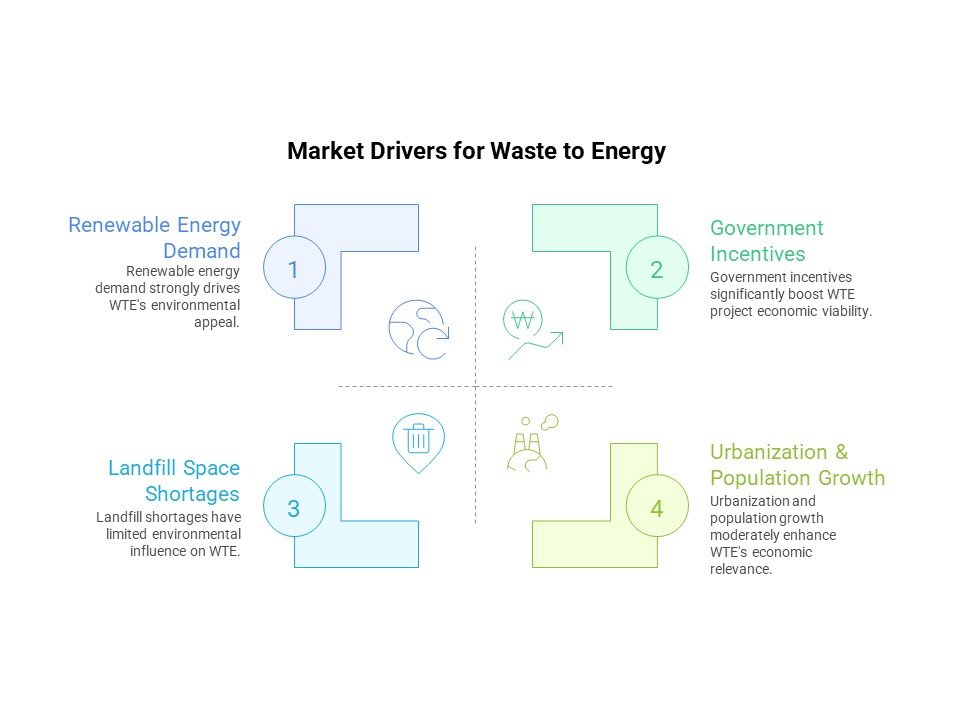
Urbanization & Population Growth
Rapid urban expansion and rising population densities are generating large volumes of municipal solid waste (MSW). Cities are increasingly relying on efficient, scalable waste management systems—like WTE—to handle this surge sustainably.
Renewable Energy Demand
With global pressure to reduce carbon emissions and transition to cleaner energy, WTE is gaining traction as a renewable energy source that complements solar and wind, especially due to its ability to provide base-load power.
Landfill Space Shortages
Many developed nations are facing a critical shortage of landfill space. WTE offers a viable solution by significantly reducing the volume of waste that ends up in landfills while also generating useful energy.
Government Incentives
Policy tools such as feed-in tariffs, carbon credit schemes, subsidies, and landfill taxes are being implemented by governments to make WTE projects financially attractive and accelerate their adoption.
Circular Economy Initiatives
WTE supports the broader goals of the circular economy by extracting energy from non-recyclable waste and promoting zero-waste principles, thereby maximizing resource efficiency, and minimizing environmental impact.
Restraints of the Waste to Energy Market:
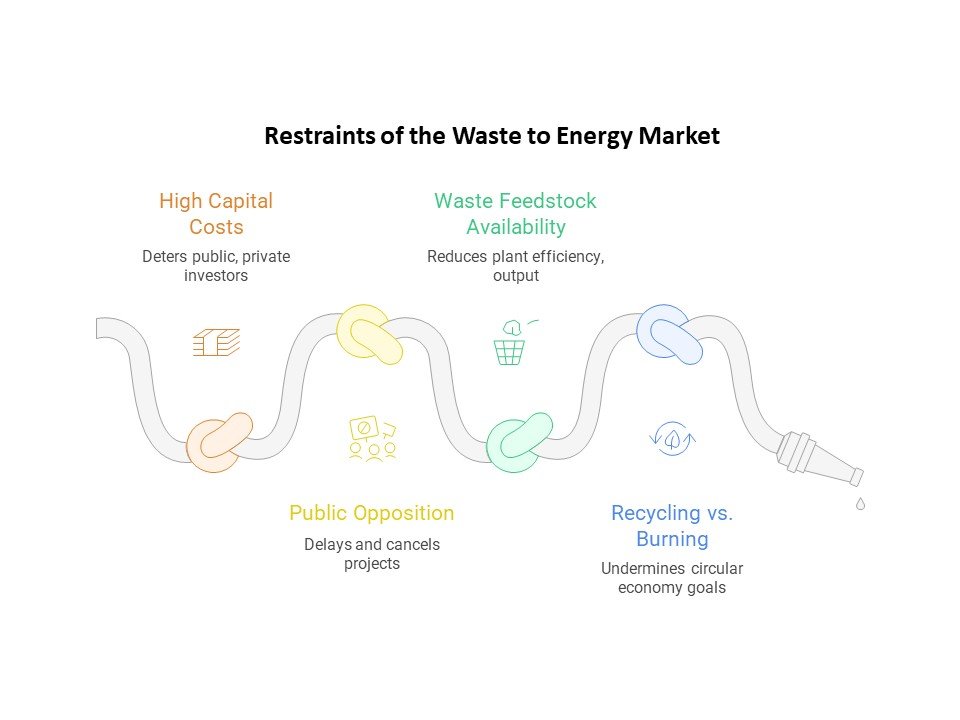
High Capital Costs
Developing a Waste to Energy facility involves substantial upfront investment in land, equipment, emission control systems, and infrastructure. These projects often require hundreds of millions of dollars and take several years before they become profitable. The long payback period and financial risk deter both public and private investors, especially in countries with limited access to green financing or subsidies. Additionally, high operating and maintenance costs further strain the project economics.
Public Opposition (NIMBYism)
The “Not in My Backyard” (NIMBY) mindset is a major barrier to WTE adoption. Local communities often resist the construction of WTE plants near residential areas due to concerns about air pollution, health risks, odor, and property value decline. Even with modern pollution control technologies, public perception remains skeptical. This opposition leads to delays in environmental clearances, legal challenges, and, in some cases, project cancellation—slowing the overall expansion of the sector.
Availability of Waste Feedstock
WTE plants require a consistent, high-quality supply of waste to operate efficiently. However, the composition and volume of municipal solid waste vary widely across regions and seasons. Poor segregation, high moisture content, or low calorific value of the waste can reduce plant efficiency and energy output. Inadequate or unreliable feedstock supply contracts make it difficult to ensure the long-term viability and profitability of WTE operations.
Recycling vs. Burning Debate
There is an ongoing debate between proponents of recycling and WTE. Critics argue that burning waste—especially plastics, paper, and metals—can discourage efforts to improve recycling rates. When recyclables are incinerated instead of being recovered, it leads to resource loss and undermines circular economy goals. This criticism fuels policy and public resistance in some regions, pressuring governments to prioritize recycling infrastructure over WTE investments, despite their complementary roles in integrated waste management systems.
Challenges in the Waste to Energy Market:
Technology Adoption in Emerging Markets
Many developing countries lack the financial resources and technical expertise required to implement advanced WTE technologies. As a result, they often rely on outdated systems or delay projects, limiting growth in regions where waste management solutions are most needed.
Regulatory Hurdles
The WTE market faces varying and often inconsistent waste management policies, permitting processes, and emission standards across countries and regions. This regulatory complexity creates uncertainty for investors and delays in project execution.
Ash Disposal and Emissions
WTE processes, particularly incineration, produce bottom and fly ash, which may contain hazardous substances. Safe handling and disposal of this ash remain a critical environmental and logistical concern. Additionally, controlling air emissions like dioxins and NOx requires costly mitigation systems.
Energy Conversion Efficiency
The energy output from WTE is often limited by the calorific value of the waste being processed. Low-quality or wet waste reduces efficiency, posing a technical barrier to maximizing energy recovery and making projects less economically viable.
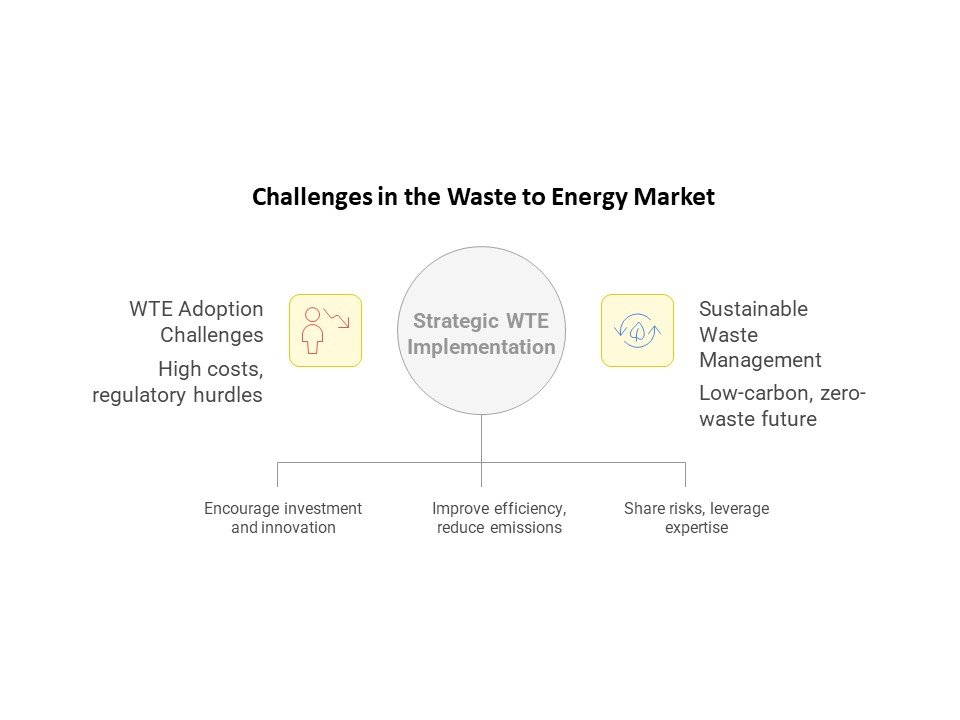
The Waste to Energy (WTE) market is being recognized as a vital element of global clean energy and circular economy strategies. Once viewed as a niche solution, it is now being embraced as a sustainable approach to waste management and renewable energy generation. Although challenges such as high capital costs, regulatory hurdles, and public perception continue to be faced, steady growth is being observed in the market. Waste is being converted into valuable energy, demonstrating that environmental responsibility and economic viability can be successfully aligned. With supportive policies, technological advancements, and increased public-private collaboration, a low-carbon, zero-waste future is being steadily advanced through innovation and necessity.