Semiconductors have become the foundation of the modern digital economy, powering everything from smartphones and electric vehicles to artificial intelligence (AI), robotics, satellites, and advanced industrial systems. As global industries accelerate their digital transformation, the demand for faster, smaller, more energy-efficient, and increasingly powerful chips is driving a new wave of technological innovation.
Next-generation semiconductors are reshaping how electronic systems process information, manage power, communicate, and perform complex computing tasks. Innovations in chip architecture, advanced packaging, specialised processors, and semiconductor materials are helping manufacturers overcome the limitations of conventional chip designs while enabling entirely new applications.
Artificial intelligence is one of the strongest forces behind this transformation. Training and operating AI models require substantial computing power, high-speed memory, and efficient data transfer. At the same time, electric mobility, connected devices, cloud computing, and autonomous technologies are expanding the need for specialised semiconductor solutions.
The scale of this opportunity is reflected in industry performance. According to the Semiconductor Industry Association (SIA), global semiconductor sales reached $791.7 billion in 2025, an increase of 25.6% over 2024. In August 2026, the SIA reported that worldwide chip sales were expected to exceed $1.5 trillion during 2026, reflecting exceptionally strong demand.
These developments highlight the strategic importance of semiconductor innovation in shaping the next generation of global industries.
Key Technologies Driving Next-Generation Semiconductors
Semiconductor evolution extends beyond reducing transistor sizes. Manufacturers are exploring new architectures, materials, and packaging approaches to improve processing performance, energy efficiency, reliability, and system integration.
Advanced chip manufacturing processes enable the integration of increasingly sophisticated transistor structures into compact devices. However, conventional miniaturization alone cannot address every performance challenge. Power consumption, heat dissipation, manufacturing complexity, and production costs continue to influence chip development.
Consequently, advanced semiconductor packaging and chiplet architectures are gaining importance. Chiplets allow different functional components to be combined within a single package, potentially improving design flexibility and manufacturing efficiency. Advanced packaging techniques also help increase communication bandwidth between processing units and memory, supporting demanding workloads such as AI acceleration and high-performance computing.
Specialised processors represent another important development. Graphics processing units (GPUs), application-specific integrated circuits (ASICs), and other accelerators are designed to handle particular workloads more efficiently than general-purpose processors in suitable applications.
Material innovation is also expanding the industry’s capabilities. Silicon remains central to semiconductor manufacturing, while materials such as silicon carbide (SiC) and gallium nitride (GaN) are increasingly important in selected power-electronics applications. Their properties can support efficient power conversion in electric vehicles, industrial equipment, renewable-energy systems, and charging infrastructure.
Together, these technologies are enabling semiconductor manufacturers to develop solutions tailored to increasingly complex performance and energy requirements.
Applications Across AI, Automotive, Telecommunications, and Industry
Artificial intelligence is transforming semiconductor demand by increasing the need for high-performance processors, memory, and networking components. AI data centres require specialised chips capable of processing enormous volumes of information while managing power consumption and heat generation. High-bandwidth memory (HBM), advanced accelerators, and high-speed interconnect technologies are therefore becoming increasingly important to AI infrastructure.
The automotive sector is another major driver of next-generation semiconductor innovation. Electric vehicles depend on power semiconductors, battery-management systems, motor controllers, sensors, and embedded computing platforms. Advanced driver-assistance systems (ADAS) and autonomous driving technologies also require chips that can process data from cameras, radar, and other sensors in real time. As vehicles become increasingly software-defined, semiconductor content is expanding across safety, connectivity, entertainment, and vehicle-control functions.
Telecommunications is creating additional opportunities through 5G infrastructure, emerging 6G research, and increasingly connected devices. Network equipment requires specialised processors, radio-frequency components, power-management chips, and high-speed data-processing capabilities. These technologies support faster communication, improved network efficiency, and the development of connected industrial systems.
In industrial manufacturing, next-generation semiconductors enable robotics, machine vision, predictive maintenance, industrial automation, and real-time process control. Small, energy-efficient chips are also essential to the expansion of the Internet of Things (IoT), where thousands of connected devices may operate under strict cost, size, and power constraints.
Healthcare and aerospace applications further demonstrate the versatility of semiconductor technology. Medical imaging equipment, diagnostic instruments, wearable devices, satellite communications, navigation systems, and advanced defence electronics rely on specialised chips designed for performance and reliability. Across these sectors, semiconductor innovation is becoming a fundamental enabler of smarter, more connected systems.
Semiconductor Manufacturing and Global Market Opportunities
The semiconductor industry is experiencing significant investment in fabrication facilities, advanced packaging, chip design, and supporting infrastructure. Governments and private companies are working to strengthen domestic manufacturing capabilities, diversify supply chains, and reduce exposure to disruptions in strategically important technologies.
Global chip demand also creates opportunities for companies involved in semiconductor equipment, electronic materials, testing, packaging, and specialised manufacturing services. As chip designs become more complex, manufacturers increasingly depend on precision process control, sophisticated inspection systems, and data-driven production methods to maintain quality and improve yields.
India is also developing its semiconductor ecosystem through initiatives supporting chip design, fabrication, packaging, testing, research, and workforce development. Government information published in August 2026 highlights the country’s efforts to strengthen domestic capabilities and build a more integrated semiconductor and AI ecosystem.
For businesses, these developments create opportunities to participate in semiconductor design services, electronic manufacturing, equipment supply, component testing, and advanced packaging. Building expertise in specialised applications and establishing partnerships with global manufacturers may help companies access a wider range of opportunities across the value chain.
However, market growth should not be interpreted as uniform expansion across every segment. Demand differs between AI accelerators, memory chips, automotive components, analogue devices, and consumer electronics. Manufacturers must align their investment priorities with specific customer requirements, technology roadmaps, and long-term demand patterns.
Challenges Shaping the Future of Semiconductor Innovation
Despite strong demand, the semiconductor industry faces several technical and commercial challenges. Advanced fabrication facilities require substantial capital investment, specialised equipment, reliable utilities, and highly skilled personnel. Manufacturing at increasingly advanced process nodes can also introduce greater complexity in process control, defect detection, and production yields.
Energy consumption is another important consideration. Semiconductor fabrication facilities require significant electricity, water, and carefully controlled operating environments. Meanwhile, AI data centres are increasing demand for high-performance chips that can deliver greater computing capacity without proportionately increasing power consumption and cooling requirements.
Supply-chain resilience remains equally important. Semiconductor production depends on internationally distributed suppliers of equipment, materials, chemicals, software, and manufacturing services. Geopolitical tensions, trade restrictions, material shortages, and logistical disruptions can affect production schedules and investment decisions. Industry executives identified supply-chain flexibility and adaptability as a leading strategic priority in the Global Semiconductor Alliance and KPMG’s 2026 industry outlook.
Rapid technological change also increases the need for continuous research and development. Companies must balance innovation with product reliability, manufacturing costs, intellectual-property protection, and time to market. Addressing these challenges will require collaboration between chip designers, equipment manufacturers, research institutions, governments, and end-user industries.
Future Outlook: Building a More Intelligent Digital World
The future of next-generation semiconductors will be influenced by the convergence of AI, advanced computing, power electronics, connected infrastructure, and specialised chip architectures. Rather than relying exclusively on smaller transistors, the industry is likely to pursue a combination of advanced manufacturing, chiplet integration, improved memory bandwidth, and more efficient system-level design.
Emerging applications will create demand for chips tailored to specific requirements. AI processors will focus on computing throughput and energy efficiency, while automotive semiconductors will prioritise functional safety and reliability. Power semiconductor technologies will support electrification, renewable energy, and efficient industrial systems, while specialised edge processors will enable more data processing directly within connected devices.
Sustainability will also remain an important consideration. Improvements in chip efficiency, fabrication processes, water management, and manufacturing resource utilisation can help address the environmental impact associated with increasing semiconductor demand.
For manufacturers, technology developers, and investors, long-term competitiveness will depend on innovation, operational resilience, specialised expertise, and the ability to translate research into commercially viable products. Organisations that understand changing application requirements and build strong industry partnerships will be better positioned to participate in the evolving semiconductor ecosystem.
Conclusion
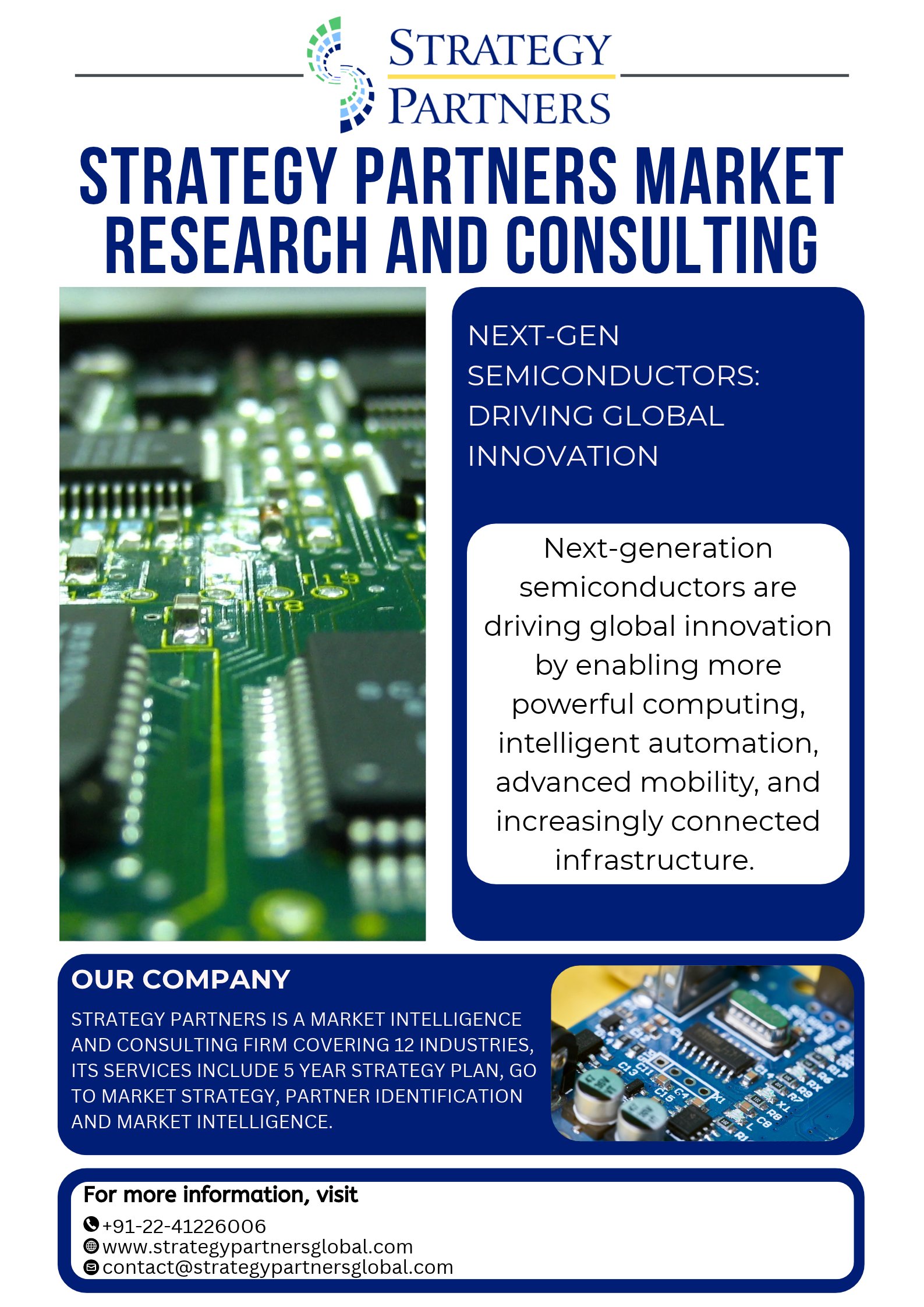
Next-generation semiconductors are driving global innovation by enabling more powerful computing, intelligent automation, advanced mobility, and increasingly connected infrastructure. Developments in AI processors, advanced packaging, chiplet architectures, and power semiconductor materials are expanding the capabilities of electronic systems across numerous industries.
Although high manufacturing costs, resource requirements, and supply-chain vulnerabilities remain significant challenges, continued investment in research, manufacturing, and specialised chip design is creating new opportunities throughout the semiconductor value chain.
As digital transformation accelerates, next-generation semiconductor technology will remain a critical foundation for industrial competitiveness, technological progress, and the future of global innovation.