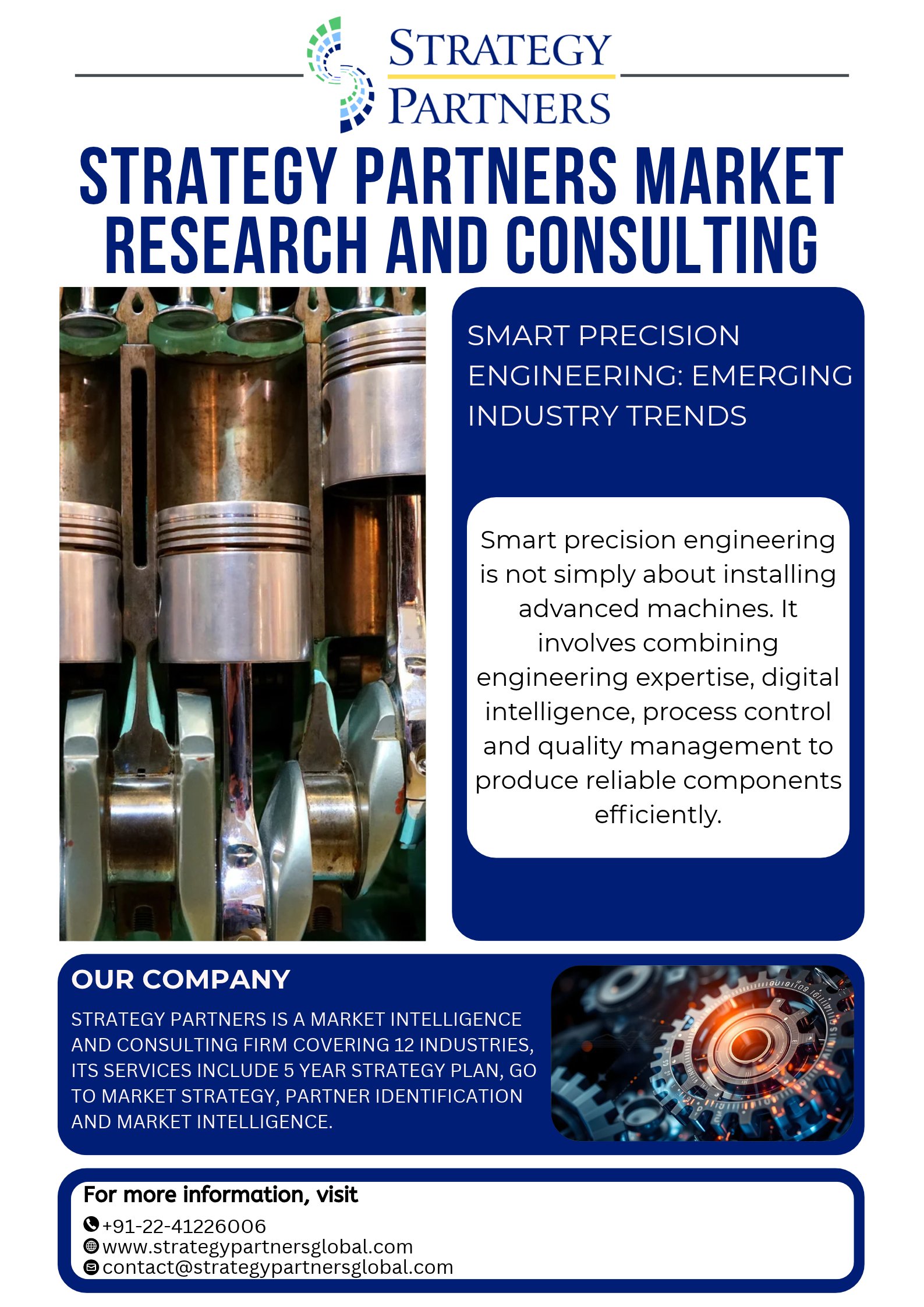
Smart precision engineering is transforming modern manufacturing by combining advanced machining technologies, digital systems, automation and data-driven quality control. As industries demand components with tighter tolerances, greater reliability and improved performance, manufacturers are adopting intelligent production methods to improve efficiency and maintain consistent quality.
Precision engineering involves designing and manufacturing components to exact dimensional and performance specifications. These components are essential in aerospace, defence, automotive, medical devices, electronics, industrial machinery and energy systems. Smart precision engineering takes this process further by integrating digital technologies, connected machines and intelligent inspection systems throughout the manufacturing lifecycle.
The shift towards smart manufacturing is driven by the need to reduce production costs, minimise material waste, improve product consistency and respond quickly to changing customer requirements. With Industry 4.0 technologies becoming more accessible, precision engineering companies are increasingly investing in automated production, real-time monitoring and advanced manufacturing solutions.
Key Technologies Transforming Smart Precision Engineering
One of the most significant developments in precision engineering is the integration of computer numerical control (CNC) machining with digital manufacturing systems. Modern CNC machines can manufacture complex components with high dimensional accuracy and repeatability. Multi-axis machining centres enable manufacturers to produce intricate geometries while reducing the need for multiple setups, helping improve productivity and minimise errors.
Advanced CNC systems are increasingly connected to manufacturing execution systems, design software and production monitoring platforms. This connectivity allows manufacturers to track machine performance, monitor production progress and identify inefficiencies. By integrating computer-aided design (CAD) and computer-aided manufacturing (CAM), engineering teams can improve the transition from component design to finished production.
Artificial intelligence (AI) and machine learning are also creating new opportunities for smart precision manufacturing. These technologies can analyse machine data, identify unusual operating patterns and support predictive maintenance. Instead of waiting for equipment to fail, manufacturers can use condition-monitoring data to identify potential problems and schedule maintenance before significant disruptions occur.
AI-assisted inspection can also help analyse measurement results, detect defects and identify recurring quality issues. However, its effectiveness depends on reliable data, suitable algorithms and validation against established inspection standards. Human expertise remains important for interpreting results and making critical engineering decisions.
Industrial automation and robotics are further improving precision manufacturing. Robotic systems can support machine loading and unloading, material handling, repetitive assembly and selected inspection activities. Automated production cells can reduce manual handling, improve consistency and help manufacturers operate equipment more efficiently.
Collaborative robots, commonly known as cobots, can assist workers with repetitive tasks while supporting flexible production environments. For precision engineering companies serving multiple industries, this flexibility can be valuable when product designs, batch sizes and customer specifications change frequently.
Another important development is the use of advanced metrology and digital inspection technologies. Coordinate measuring machines (CMMs), laser scanners, optical measurement systems and in-process probing allow manufacturers to verify component dimensions against engineering specifications. Integrating inspection data with production systems can help identify deviations earlier and reduce the cost of rework and rejected components.
Emerging Industry Trends and Market Opportunities
The growing adoption of Industry 4.0 is one of the defining trends in smart precision engineering. Connected machines, industrial Internet of Things (IIoT) sensors and manufacturing software enable companies to collect and analyse production data across different stages of the manufacturing process. This visibility can help improve machine utilisation, monitor quality and identify bottlenecks.
Digital twins are gaining attention as another emerging technology. A digital twin is a virtual representation of a physical component, machine or manufacturing process that can be updated using operational data. In precision engineering, digital twins can support design validation, process simulation, equipment monitoring and production optimisation. Their value depends on the accuracy of the underlying models and the availability of reliable data.
Additive manufacturing is also expanding the possibilities for precision component production. Unlike conventional subtractive machining, which removes material from a workpiece, additive manufacturing builds components layer by layer. It can support complex geometries, lightweight structures and specialised designs that may be difficult or expensive to manufacture using traditional methods.
In some applications, additive manufacturing is combined with CNC machining to achieve the required surface finish, dimensional accuracy and functional tolerances. This hybrid approach can be useful for specialised aerospace, medical and industrial components, although material qualification, production repeatability and post-processing remain important considerations.
Advanced materials are influencing precision engineering requirements as well. Aerospace and defence manufacturers increasingly work with titanium alloys, high-strength steels, nickel-based superalloys, aluminium alloys and advanced composites. These materials can deliver specialised mechanical, thermal or weight-related properties, but they may also require sophisticated tooling, optimised cutting parameters and carefully controlled machining conditions.
Sustainable manufacturing is becoming an important consideration for precision engineering businesses. Companies are exploring energy-efficient machine tools, improved cutting-fluid management, material optimisation and recycling initiatives to reduce environmental impact. Process monitoring can help identify excessive energy consumption, while better production planning can reduce scrap and unnecessary machine operation.
The automotive industry’s transition towards electric vehicles is creating additional demand for specialised precision components. Electric motors, transmission systems, battery manufacturing equipment, thermal-management systems and power electronics all require components manufactured to appropriate dimensional and functional specifications. Precision engineering suppliers are adapting their capabilities to support these evolving requirements.
Aerospace and defence remain important application areas because components used in aircraft, propulsion systems, landing gear, navigation equipment and defence platforms must satisfy demanding quality and traceability requirements. Smart manufacturing can help suppliers maintain production records, improve inspection consistency and support compliance with customer-specific standards.
Challenges and the Future of Smart Precision Engineering
Despite its advantages, implementing smart precision engineering requires careful investment and planning. Advanced CNC machines, robotics, metrology equipment, software platforms and industrial connectivity systems can involve substantial upfront costs. Small and medium-sized manufacturers may face difficulties adopting these technologies without clear investment priorities and a realistic implementation roadmap.
Workforce development is another challenge. Modern precision engineering requires a combination of traditional machining knowledge and digital skills, including CNC programming, CAD/CAM operation, data analysis, automation maintenance and quality engineering. Training existing employees and recruiting specialised personnel will be essential as production systems become more connected.
Cybersecurity is also increasingly important. Connected manufacturing equipment can create additional risks if industrial networks and operational data are not adequately protected. Manufacturers need suitable access controls, network security, software updates and data-management procedures to protect production continuity and sensitive customer information.
Looking ahead, smart precision engineering is expected to become more integrated, automated and data-driven. AI-supported process optimisation, autonomous inspection, advanced robotics and connected production systems could improve manufacturing flexibility and consistency. At the same time, digital documentation and traceability will remain essential for industries where component performance and reliability are critical.
For India, smart precision engineering presents opportunities to strengthen domestic manufacturing and expand participation in global supply chains. Investments in advanced machining, metrology, workforce training and digital production systems can help Indian manufacturers serve aerospace, defence, automotive, medical and industrial customers. Collaboration between original equipment manufacturers, component suppliers, technology providers and research institutions will be important for accelerating adoption.
Ultimately, smart precision engineering is not simply about installing advanced machines. It involves combining engineering expertise, digital intelligence, process control and quality management to produce reliable components efficiently. Companies that adopt these technologies strategically can improve operational performance, respond to increasingly demanding specifications and build stronger capabilities for the next generation of manufacturing.