
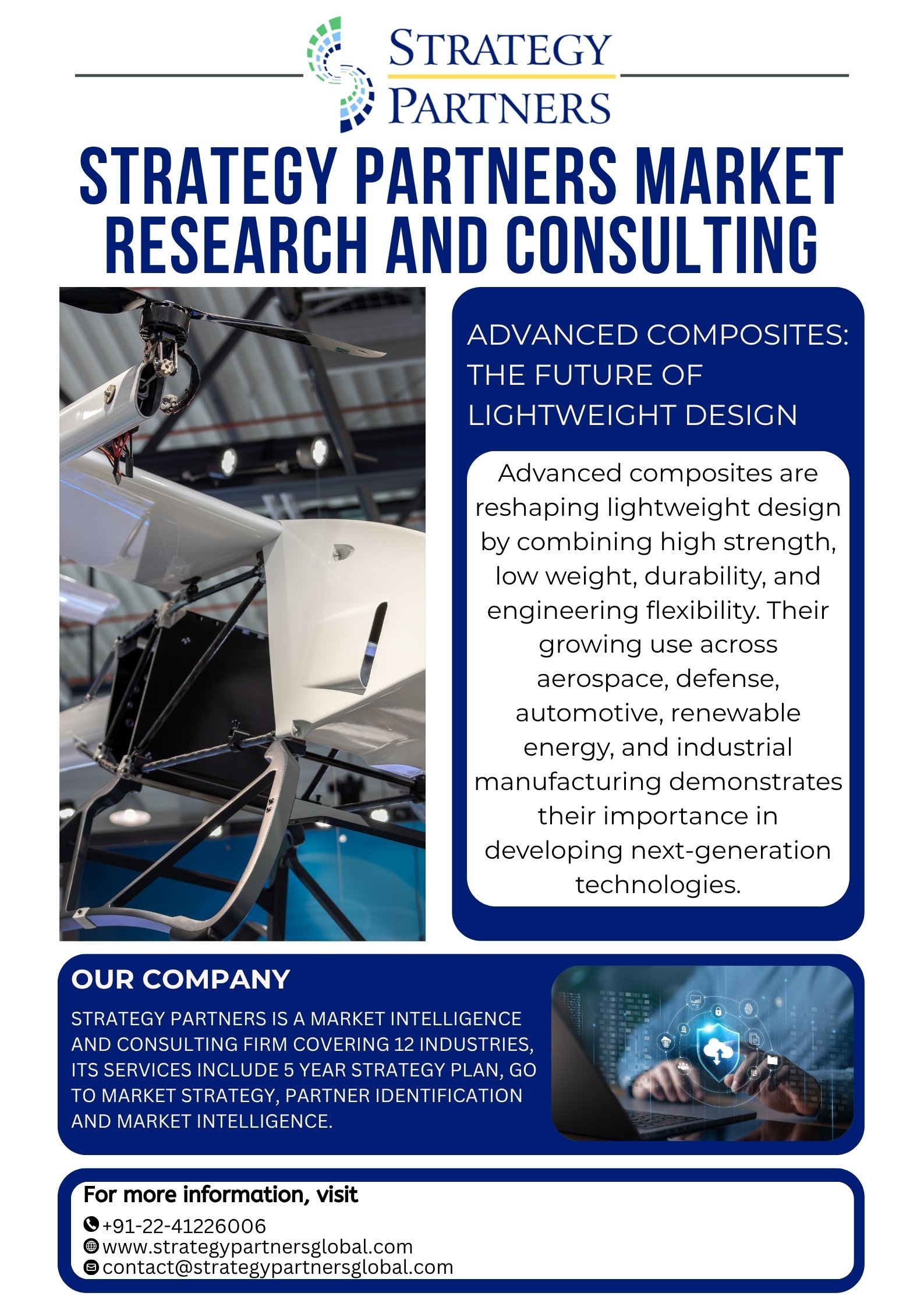
Advanced Composites: The Future of Lightweight Design
Advanced composites are transforming modern engineering by offering a combination of lightweight construction, high strength, durability, and design flexibility. As industries seek to improve performance, reduce energy consumption, and develop more efficient products, composite materials are becoming increasingly important. From aerospace and defense to automotive, renewable energy, and industrial manufacturing, advanced composites are enabling engineers to create structures that are lighter, stronger, and more efficient than many conventional materials.
Lightweight design has become a strategic priority for manufacturers because reducing structural weight can improve fuel efficiency, increase payload capacity, lower operating costs, and enhance overall performance. With continued advancements in material science, manufacturing processes, and digital engineering, advanced composites are expected to play a significant role in the next generation of industrial and transportation technologies.
What Are Advanced Composites?
Advanced composites are engineered materials made by combining two or more distinct constituents to achieve improved mechanical and physical properties. Typically, they consist of reinforcing fibres embedded within a matrix material. The fibres provide strength and stiffness, while the matrix holds the fibres together, transfers loads, and protects them from environmental damage.
Carbon fibre-reinforced polymers (CFRP), glass fibre-reinforced polymers (GFRP), and aramid fibre composites are among the most widely used advanced composite materials. Carbon fibre composites are valued for their high strength-to-weight ratio and stiffness, making them suitable for demanding aerospace and automotive applications. Glass fibre composites offer a cost-effective balance of strength, durability, and corrosion resistance, while aramid fibres are known for impact resistance and energy absorption.
Advanced composites can also incorporate ceramic or metal matrices, depending on the operating environment and performance requirements. Ceramic matrix composites, for example, can withstand extremely high temperatures and are used in selected aerospace propulsion and industrial applications. The choice of composite depends on factors such as structural loads, temperature, weight restrictions, manufacturing costs, and service life.
Key Benefits of Advanced Composites in Lightweight Design
One of the most significant advantages of advanced composites is their exceptional strength-to-weight ratio. By reducing structural mass without compromising essential performance requirements, these materials help engineers develop efficient aircraft, vehicles, spacecraft, and industrial equipment. In aviation, lighter structures can contribute to lower fuel consumption and increased payload capacity. In automotive applications, weight reduction can support improved energy efficiency and extended electric vehicle range.
Another important benefit is design flexibility. Composite materials can be engineered with specific fibre orientations, layer arrangements, and material combinations to meet different structural requirements. This allows manufacturers to optimise components for strength, stiffness, vibration control, and fatigue performance. Complex shapes can also be manufactured with fewer individual parts, potentially reducing assembly requirements and simplifying structural design.
Corrosion resistance is another advantage, particularly in marine, chemical processing, and infrastructure applications. Unlike many conventional metals, polymer-based composites do not rust, although their resistance to chemicals, moisture, ultraviolet exposure, and temperature variations depends on the material system and protective measures used.
Advanced composites can also provide excellent fatigue performance when properly designed and manufactured. However, their performance depends on fibre architecture, matrix properties, manufacturing quality, and the presence of defects. Careful inspection and testing remain essential to ensure long-term structural reliability.
Applications Across Aerospace, Defense, and Automotive Industries
The aerospace industry is one of the leading adopters of advanced composites. Modern commercial aircraft use composite materials in major structural components, including wings, fuselage sections, tail assemblies, and control surfaces. These materials help reduce aircraft weight while supporting aerodynamic efficiency and structural performance. Composite structures also offer design opportunities that can improve component integration and reduce the number of fasteners and joints.
In the defense sector, advanced composites are used in aircraft structures, unmanned aerial vehicles, missile components, radomes, protective equipment, and selected naval platforms. Their low weight and high specific strength can support mobility, payload efficiency, and mission endurance. Radar-transparent composite materials are particularly useful for radomes, where electromagnetic performance must be balanced with structural strength and environmental durability. Specialized composite systems may also provide thermal protection or impact resistance for demanding applications.
The automotive industry is increasingly exploring composites to improve vehicle efficiency and performance. Carbon fibre components are used in selected high-performance vehicles, while glass fibre composites are common in body panels, structural parts, and other components. Electric vehicle manufacturers are investigating lightweight composite structures to offset battery mass and improve driving range. However, widespread adoption depends on material costs, high-volume production rates, repairability, and end-of-life recycling solutions.
Beyond transportation, advanced composites are widely used in wind turbine blades, pressure vessels, sports equipment, marine structures, and industrial machinery. Wind turbine blades rely on composite materials to achieve the required length, stiffness, and fatigue resistance while managing structural weight. In renewable energy systems, advances in composite manufacturing can help support larger and more efficient turbine designs.
Manufacturing Innovations Driving Composite Technology
The development of advanced composites is closely linked to improvements in manufacturing technology. Traditional processes, such as hand lay-up and autoclave curing, remain important for specialised components, particularly where strict quality requirements apply. However, these methods can involve high costs, long production cycles, and substantial labour requirements.
Automated fibre placement and automated tape laying are helping manufacturers produce complex composite structures with greater consistency and reduced manual effort. These technologies place reinforcing fibres or prepreg tapes along programmed paths, enabling precise control over fibre orientation and material distribution. They are especially valuable in aerospace manufacturing, where structural performance and quality assurance are critical.
Resin transfer moulding and related liquid composite moulding techniques can support repeatable production and improved manufacturing efficiency. Out-of-autoclave curing methods are also attracting interest because they can reduce dependence on expensive autoclave equipment for suitable applications. In addition, thermoplastic composites offer potential advantages in faster processing, impact resistance, and remoulding or welding, depending on the material system.
Digital engineering is further improving composite development. Simulation tools can help engineers analyse fibre orientation, structural loads, thermal behaviour, and potential failure mechanisms before physical production begins. Digital twins, process monitoring, and non-destructive inspection technologies can support quality control throughout the component lifecycle.
Challenges and Future Trends in Advanced Composites
Despite their advantages, advanced composites face several challenges. Carbon fibre materials and specialised manufacturing processes can be expensive, limiting their use in cost-sensitive applications. Composite structures can also be more difficult to inspect and repair than conventional metal components. Internal defects, delamination, and impact damage may not be immediately visible, making specialised inspection methods important.
Recycling remains another major challenge, particularly for thermoset composites, which cannot simply be melted and reshaped like many thermoplastics. Mechanical recycling, chemical recovery, and thermal processing are being developed to recover fibres and reduce waste, although recovered materials may not retain all the properties of virgin fibres. Designing components for easier disassembly and recycling is therefore becoming increasingly important.
Future developments are likely to focus on lower-cost carbon fibres, recyclable resin systems, thermoplastic composites, multifunctional materials, and automated high-volume manufacturing. Researchers are also exploring self-sensing composites that can help monitor structural strain or detect damage, as well as hybrid structures that combine composites with metals or other materials to balance performance, cost, and manufacturability.
In aerospace and defense, continued demand for efficiency, payload optimisation, and advanced structural performance will encourage further research into high-temperature composites, lightweight protective structures, and next-generation manufacturing techniques. In automotive and renewable energy applications, improvements in production speed and recycling could expand the use of composites across a wider range of products.
Conclusion
Advanced composites are reshaping lightweight design by combining high strength, low weight, durability, and engineering flexibility. Their growing use across aerospace, defense, automotive, renewable energy, and industrial manufacturing demonstrates their importance in developing next-generation technologies.
Although cost, repair complexity, manufacturing scalability, and recycling remain significant challenges, continuous innovation is improving the performance and commercial potential of composite materials. As manufacturers adopt automated production, digital engineering, and more sustainable material systems, advanced composites will remain a key technology for creating lighter, more efficient, and high-performance structures.