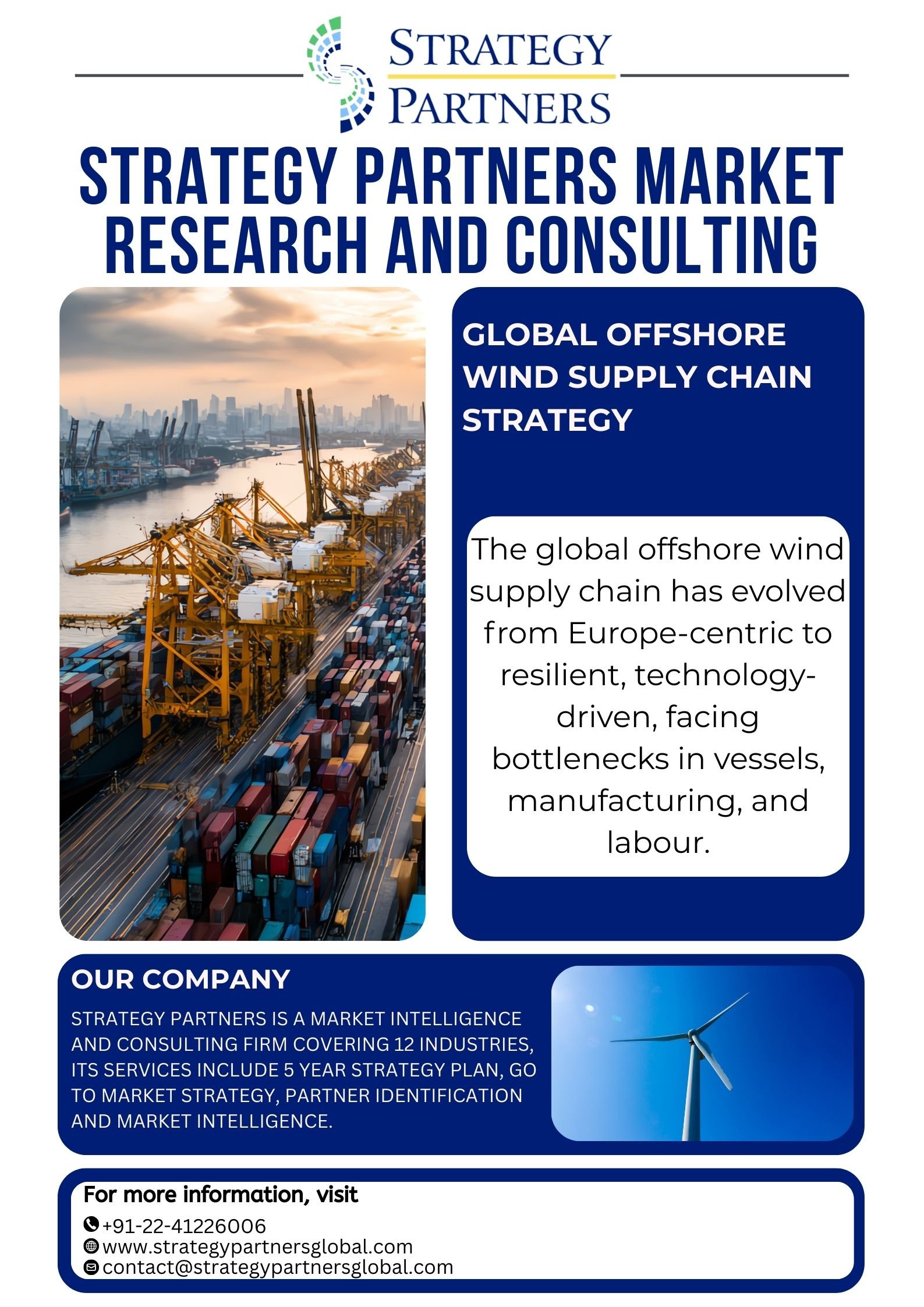
Global Offshore Wind Supply Chain Strategy: Evolution and Outlook
The global offshore wind industry is now a vital part of the clean energy shift. Net-zero commitments and the need for reliable renewable power are driving this change. Previously, offshore wind was limited to a few European nations. However, it has now expanded to Asia-Pacific, North America, and emerging markets like India and Brazil. Consequently, the need for a strong supply chain has grown.
A global supply chain strategy focuses on improving manufacturing, logistics, and operations. It also supports workforce systems for turbine production and grid integration. Furthermore, it involves policy support and securing raw materials. However, demand is currently growing faster than supply. As a result, the industry faces bottlenecks. These include vessel shortages, high costs, and workforce gaps. Therefore, the supply chain must evolve from old models to flexible, future-ready systems.
Looking Back: The European Foundation
From the early 2000s to the mid-2010s, Europe dominated the market. Development was concentrated in the UK, Germany, Denmark, and the Netherlands. Historically, the strategy focused on cutting costs. It relied on a small group of suppliers like Vestas and Ørsted. This approach allowed for economies of scale. However, it also created regional dependency.
During this period, turbines were small, typically 3–5 MW. Therefore, they required simple ports and vessels. Growth was driven mainly by stable government incentives. Consequently, suppliers could plan easily. While this strategy worked for early projects, it lacked the capacity for global expansion.
Current State: Rapid Expansion & Growing Pains
Today, the supply chain is scaling up rapidly. Countries like the U.S., China, and South Korea have aggressive targets. Moreover, turbine sizes have grown significantly. The industry standard is now 12–18 MW, with 20-MW models in development. As a result, logistical needs have increased sharply.
Current strategies focus on expanding production and upgrading ports. Additionally, governments are introducing mandates to support local industries. However, there are significant disruptions. Steel prices are volatile, and inflation is rising. Furthermore, there is a shortage of skilled labor. To address this, companies are adopting sustainable practices. For instance, they are using low-carbon manufacturing and AI to optimize supply chains.
Future Outlook (2025–2035): Innovation & Resilience
Looking ahead, the future strategy will focus on massive manufacturing and new technologies. Global capacity targets will soon exceed 500 GW. Therefore, countries will build “gigafactories” for blades, cables, and foundations. Additionally, floating wind will open new markets in deep waters. This will create a demand for new mooring systems and floating platforms.
Digital transformation will also play a key role. For example, AI and robotics will improve planning. Sustainability will be equally important. The industry will shift toward green steel and recyclable blades. Furthermore, workforce training will use VR and automation to solve labor shortages. Ultimately, the future strategy will prioritize scale and resilience.
Key Growth Drivers
-
Policy Support: Governments are setting strong net-zero targets. Mechanisms like tax incentives provide financial safety. Consequently, this boosts investment.
-
Energy Security: Countries want to reduce reliance on imported fossil fuels. Offshore wind provides a reliable domestic energy source. Thus, it improves stability.
-
Technology: Turbines are getting bigger and more efficient. Additionally, automation improves reliability. These innovations attract more investors.
-
Floating Wind: This technology opens up deep-water markets. It allows projects near major coastal cities. Therefore, it expands the supply chain significantly.
-
Investment: Oil and gas companies are investing heavily. Strong partnerships are increasing confidence. As a result, manufacturing is expanding.
Major Restraints
-
High Costs: Offshore wind requires expensive factories and vessels. These upfront costs slow down approval processes. This is especially true in emerging markets.
-
Permitting Delays: Obtaining permits takes a long time. Complex rules delay project timelines. Consequently, this discourages investment.
-
Component Shortages: There is a global lack of cables and transformers. Competition for materials causes delays. Therefore, project execution slows down.
-
Economic Pressure: Rising material prices affect budgets. Inflation increases financing costs. As a result, some projects become unviable.
-
Infrastructure Gaps: Many regions lack the necessary ports. There are not enough specialized vessels. This limits how fast the industry can grow.
-
Localization Issues: Emerging markets often lack skilled local suppliers. Strict local content rules add complexity. Thus, development slows down.
Critical Challenges
-
Vessel Shortage: The current fleet is too small for modern turbines. Building new vessels takes time and money. Therefore, bottlenecks occur.
-
Skills Gap: There are not enough engineers or technicians. Training programs are lagging behind. Without skilled workers, productivity suffers.
-
Geopolitical Risks: Relying on specific regions for materials is risky. Trade restrictions can threaten manufacturing. Consequently, costs may become unstable.
-
Grid Bottlenecks: Transmission capacity is often limited. Delayed connections stop power from reaching the grid. This affects system reliability.
-
Rapid Innovation: Technology changes quickly. Infrastructure can become outdated fast. Therefore, constant upgrades are required.
Conclusion
In summary, the offshore wind supply chain is evolving. It is moving from a cost-driven, European model to a global, high-tech ecosystem. However, rapid growth creates bottlenecks in manufacturing and labor. To succeed, future strategies must focus on scale and digitalization. Moreover, they must prioritize sustainability. This will enable true global decarbonization.